

At the mouth of the Strait of Gibraltar, Tangier gleams white against the sea. A port that has changed hands so many times, its Berber, Arab, Spanish, and Roman influences still tangle together in the tongues on the streets.
Legend says that Hercules himself carved the strait, splitting a single mountain in two to raise the Pillars of Hercules – the Rock of Gibraltar on the European side and a peak facing it across the water in Africa.
You can still visit the caves where Hercules was rumoured to have rested before or after seeking the golden apples of the Hesperides. You will find a carving in the rock that resembles the map of Africa.

At Cap Spartel I climbed 30m to the top of the lighthouse. I looked out to where the muscular Atlantic jostles with the Mediterranean. The wind blew hard off the sea, working the palms and peppering the coast with fan palm seeds.


But despite the coast’s rawness, find a spot to overlook the town, and it’s surprisingly calm – with the odd interruption. A house sparrow sings in a tree; a motorbike’s throttle threads through a street below. A cockerel crows to its flock, parading the hens around the neighbourhood gardens. Compared to Marrakesh, it feels peaceful.
Then prayer commands everyone’s attention. Five times a day, its chant competes with neighbouring mosques, like kites dancing through the breeze, tangled together. Below, men sit together on the grass outside the mosques, repeating the phrases quietly to themselves.
Faith holds this community together with an openness. In the evening, men socialise together in cafeterias, while women sit together in groups with their children in the park. Walking past one afternoon, I watched a woman pick and throw fresh green grass on a grave. I caught her eye, and she smiled. Later I learned it’s an Islamic practice to seek mercy and ease the spiritual burden of the deceased.
I felt so welcomed in this city. It never felt performative like tourist destinations can – just local people going about their day, with the door open, offering tolerance and kindness.

The other residents in the city are cats. Every street has wild cats and tiny kittens. They are well cared for. Locals feed them, but street rubbish offers options, too. A pile of fish bones, a dairylea triangle – a whole separate cat world exists alongside the locals and tourists.
The area has also been a favourite place for writers and artists. Matisse came in 1912 and stayed for months. He painted one of his most famous works, the view over the medina and St. Andrew’s Church from his hotel room at the Grand Hotel Villa de France, called Landscape Viewed from a Window. I couldn’t resist seeing the view from room 35, where he stayed.


The double-aspect hotel room has retained many of its original features, such as the brass light switches, the phone, and the wooden closet and floor. I could see why Matisse liked this room, and how his art kept him company.
Asilah – the arty seaside town
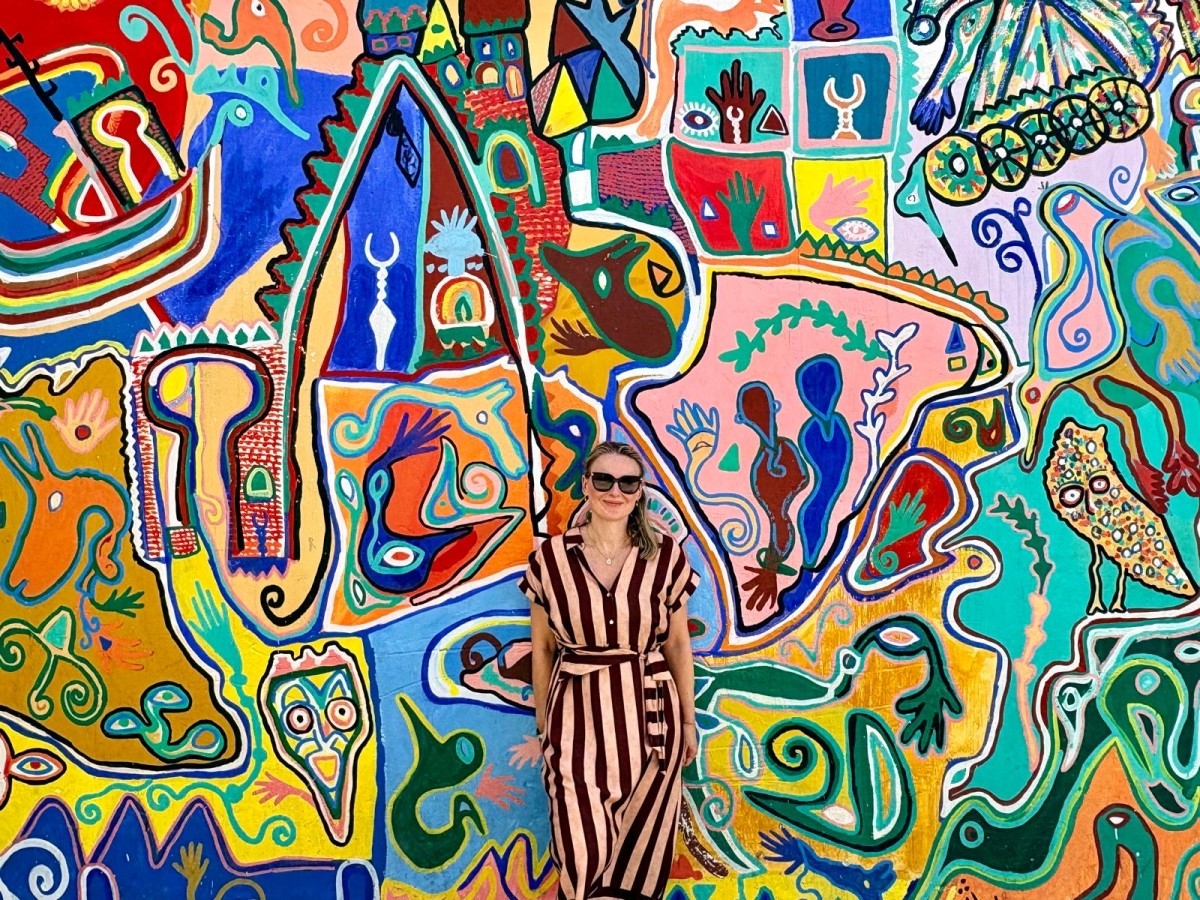
If you like art, head for Asilah, a town an hour’s drive down the coast where the Atlantic runs beside the road. This sleepy coastal village was one of my favourite places to visit. Every summer during the festival, the medina walls are painted over, making the area a living art canvas.


Intact 15th-century Portuguese ramparts ring the medina, and the Atlantic Ocean crashes hard beneath them. At certain times, the sea crashes so hard against the wall it throws a spray over the top. Local teenagers seem to play the sea at their own game, diving off the walls rather than waiting to get wet.
On a Sunday, you may hear the Church of San Bartolomé ring its bells for Sunday mass (one of the few in Morocco permitted to do so), notice a local wandering in traditional Berber attire, or hear the music from street buskers filling the white alleys with melodies. You can watch an artist create a new piece of work, or stop for some grilled sardines in one of the many fish restaurants. It’s relaxed and a lovely place to wander.
Tetouan to Chefchaouen – the blue city
Another city worth visiting lies in the Rif Mountains: Chefchaouen. Chefchaouen is a peaceful city set on a hillside with blue-washed architecture.
The conversation with our driver on the six-hour round trip was the usual game of charades: a sentence assembled from whatever French, Spanish or English words we could muster, with a mimed picture when the words ran out. One conversation was clear: the route has many police stop checks, as it’s frequented by the mafia, who use the route for drug smuggling. I settled back in my seat. I knew the journey would be interesting!
En route, we stopped in Tetouan. Its medina is a UNESCO World Heritage Site, but I had no interest in shopping or getting lost in a medina. So I agreed to stretch my legs for a short wander. The taxi driver suggested a guide, but it felt pointless for a walk around the block. So, I left him in the car and set off as the clouds covered the sky.
Within minutes, the heavens opened, and I found myself sheltering under a shop’s canopy. The lady who worked there came outside and offered me a stool. From there, through the drizzle, I watched the town go about its business. Stroking a kitten who sought refuge with me, I watched four shoe shiners working in a row, unhurried by the rain.
After a while, I thanked the lady for her hospitality and continued my wander, but the hassle was constant. I decided to try to find a toilet and head back to the taxi. All the cafeterias were full of men; there were no women in sight, but I found one aptly named ‘Café Touristes.’ I went in, ordered a mint tea, and asked to use the toilet. It was a single latrine with a curtain and a bucket of water to wash your hands. It was not the time to be fussy, so I used the facilities and sat down for tea, adjusting to the smell of tobacco hitting my eyes and throat. Suddenly I noticed a face with a shabby beard staring through the window. I could tell from the way he carried himself that he was going to cause trouble, so I put on my sunglasses, avoided contact and poured my mint tea from the silver teapot.
My husband, sitting with his back to the window, was completely unaware of the attention. But suddenly, the man appeared in the cafe and demanded something of us in Arabic. My husband gestured that he didn’t understand. But the man grabbed his shoulder, shook him and raised his voice. I suspect he was demanding money, but before I could decide what to do, a man sitting opposite started shouting at him. Then at least five other local men jumped up and threw him out into the street, which came close to a street brawl. I finished my tea.
This strengthened my faith in the kindness of the Moroccan people we met on our travels. From offering us shelter to protecting a tourist over a local, their kindness was reassuring. But needless to say, I was eager to get back on the journey to Chefchaouen, and if you visit Tetouan, I suggest a guide!
The journey continued for another hour through arid ochre farmland and up through the mountains. We passed roadside stalls selling braids of golden onions and garlic, and a couple of shepherds herding goats and cows. As we drove higher, clouds rolled over the mountains, like overflowing cream on a hot chocolate. Then, set high on the hillside, the city we came to see greeted us in shades of blue.


Chefchaouen is a mountainside city of Andalusian-style red-tiled houses, painted in shades of blue, with a maze of narrow alleys that provide shade and channels for the mountain breeze. The city is built around the Kasbah, a square surrounded by orange trees where locals and tourists meet in eateries for food or watch the world drift past with a mint tea.
Several alleys lead from the Kasbah up the mountain to riads. Along the way, many shops sell local handicrafts such as rugs, pottery, leather goods and soaps made from local ingredients.
Chefchaouen is the postcard. The blue is real, but so is the theatre around it – the locals have set up props in the prettiest corners, a few dirhams for a photograph. If you visit, it’s worth staying the night and trekking the local hills, and when the day-trippers file out, you can wander the emptying alleys during golden hour.
But the warmth I carried home from Morocco wasn’t here, on the square where a picture has a price. It was the stool pushed towards me in the Tetouan rain, and the men who rose over a glass of tea for two strangers they’d never see again. Morocco offers a welcome you can’t plan for in advance.

Leave your thoughts