

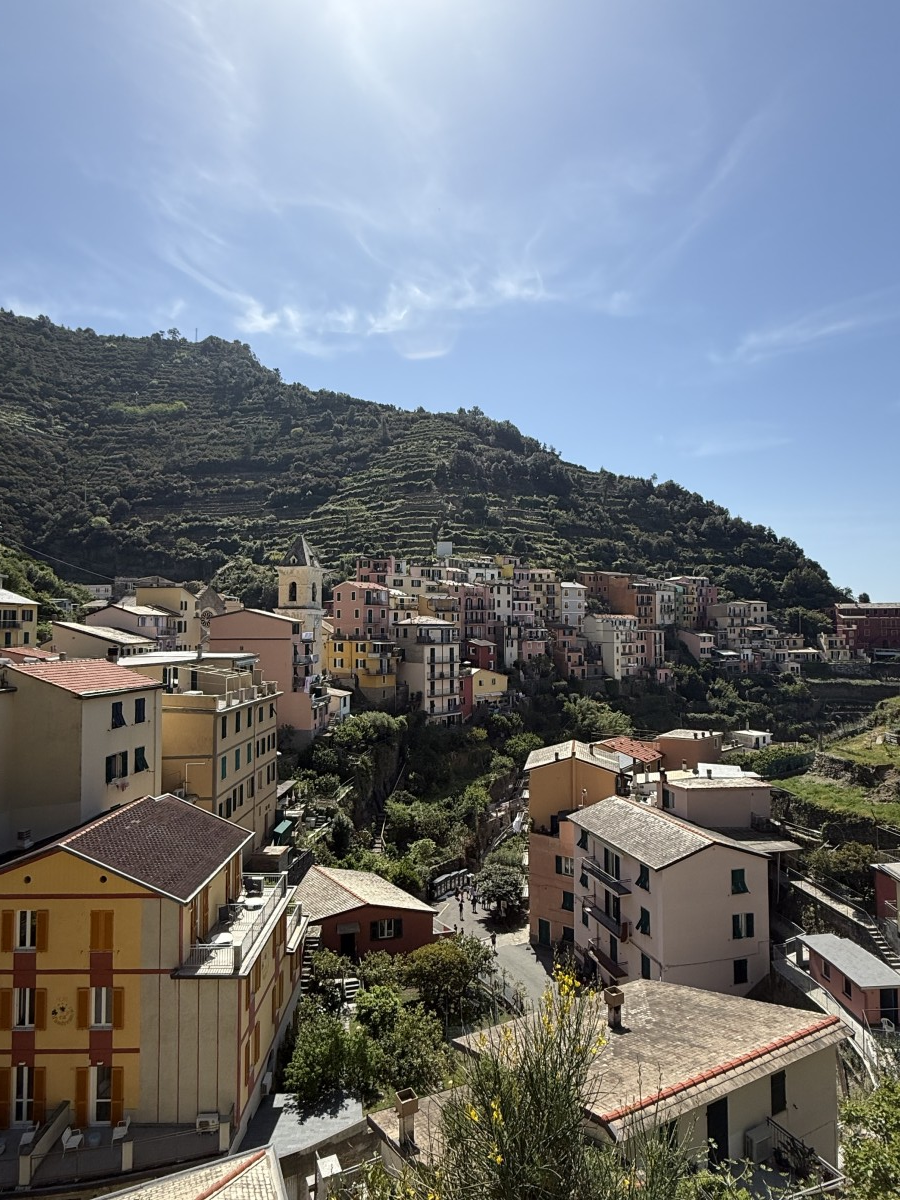
Five villages stitched into the edge of a cliff overlooking picturesque marinas or far horizons. The Cinque Terre is a National Park and UNESCO World Heritage Site, with little room for roads and no patience for ease. Visit on the land’s terms, and tread lightly as a tourist.
The cliff path entrance to Riomaggiore


The narrow trail starts at the end of the station platform, climbs around a bend in the rock-face, and the sea opens out below – that particular Ligurian blue that deepens to ink in the shadow of the rock.
The direct route would have been through the tunnel into the heart of the village. But GPS decided otherwise, and arriving this way, the first thing you notice isn’t the colour. It’s the gradient.
Riomaggiore stacks itself upward with a kind of stubborn logic – deep terracotta above ochre, above blush, above the sea. The pastels are famous for a reason that has nothing to do with tourism marketing. Fishermen painted their houses in distinctive colours so they could find their own front doors from the water. What began as a navigation aid has become an identity, drawing millions of people a year to what was once simply practical.
Behind the houses, the slopes climb on dry-stone terraces – thousands of kilometres of them, held together over centuries by people who didn’t choose this terrain so much as reach an arrangement with it.


From the balcony of our apartment, the restaurant below was less a separate place than an extension of the room. Close enough to catch the waiter’s eye as he polished cutlery, with sleeves rolled back, tattoos visible on his forearms. “Ciao,” I called. His reply was longer than my Italian could follow. He seated a woman, who took off her wide-brimmed hat, then looked directly at me, wondering if she had invited three for dinner. In a village built upward because there was nowhere else to build, the space had been negotiated away centuries ago.
The coastal walk to Manarola
We took the coastal path to Manarola the next morning, tracing the cliffs with the Ligurian sea on one side and a wall of stone on the other. The walk took in the blues of the water, the smell of salt and wild herbs, and, after twenty minutes, the village came into view.


Sitting just outside the centre, I ordered coffee and, as I reliably do in Italy, received a smaller coffee than I intended. The bell tower was ringing overlooking the village opposite – slow and unhurried. I sipped as slowly as I could manage, trying to make the cup outlast the bells. It didn’t. Manarola wasn’t a place we arrived at so much as one we passed through, caught mid-breath between the easy coastal path behind us and the mountain the map was already threatening ahead.
Just as we were leaving, I heard a revving further down the lane. A small grey trike came into view, spluttering up the hill in second gear at a pace you could comfortably overtake on foot. The driver had one elbow out of the window and the resigned expression of a man who does this run several times a day. It was Claudio, the luggage transfer service, negotiating somebody’s holiday up the hill. I realised another mistake I’d made on this holiday – a heavy rucksack.
“The trike didn’t so much drive up the hill as argue with it – and the hill, as always, had the last word.”
The eternal mountain trek to Corniglia
The trek to Corniglia over the mountains is a proposition entirely different to the coastal path. Steps. Many steps. Slate and stone, worn smooth by feet going back further than memory. The path begins with farmers’ fields spread across the hilltops, rows of vegetables carved into the slope with the same patient logic as the vineyards above them. These are the vineyards that produce Sciacchetrà, the sweet wine for which the terraces exist, pressed from grapes that ripen high over the village. The vineyards coexist with fauna and cacti dotted along the route.

The climb to Volastra felt eternal. Dragging myself up the last few steps into the village, I noticed a defibrillator hanging on the wall – a sign that more people had felt robbed at this point. The fountain next to it offered a chance to cool down, giving temporary relief. Volastra is wrapped in olive groves and has the welcoming grace of shaded benches outside its church. The Shrine of Our Lady della Salute dates back to the 12th Century and is built in a Romanesque style with a modern stone interior. It gave me a moment’s refuge and held my prayer of safe passage before I mustered the energy for the next stage.


An hour further into the trek, at the top of the mountain, a vineyard came into view, set up with tables and chairs in the afternoon light. It’s not every day you find a bar on a mountain ledge, a good walk in either direction from anywhere. Deep amber glasses of wine sat in people’s hands above a horizon line in the distance. This was what the Sciacchetrà grapes had been climbing toward – ending in someone pouring you a glass at the edge of the sheer mountain drop. It isn’t advertised. People stumble across it and sit down because it’s the only sensible thing to do.
From here, the path narrows, the dramatic coastline disappears, and the trail winds into thick tree line offering shade and silence, apart from a blackcap singing somewhere overhead in the trees, and light falling through in patches.
Corniglia – The village that naturally manages tourism numbers
Corniglia, when we finally reached it, defeated us in the best possible way. Exhausted, we instinctively followed other walkers down 383 steps to the train station, searching for water and lunch.
Corniglia, one of the five villages, sits not on the water but above it, and it will forever be the village that refused even the sea’s invitation to come down, let alone us. Corniglia is the most isolated village in the Cinque Terre. It sits like a balcony over the sea. In our defeat, we understood something the village had known all along. The village is exposed to harsh sunlight, sea winds and sparse vegetation. Whilst it welcomes tourists, it can only cater for so many- the natural selection of walkers who accidentally pass it by provides natural crowd control.
At this point, our legs trembled with compassion for the trike, and no one had the will to climb back up. So, respecting Corniglia’s wild and isolated beauty, we took a final glance at her, perched on the hill, and took the train back to Riomaggiore.
Monterosso by Sea
The ferry to Monterosso takes roughly forty minutes. Two dolphins swam alongside us for a while, curving through the bow wake with easy confidence. I watched them peel away, enjoying another side of the Cinque Terre.


Monterosso is the largest of the five villages and the most immediately welcoming. Pastel buildings with shuttered windows and hanging laundry connect cobbled alleys that lead down to a pebble beach. The old town is striped – its Chiesa di San Giovanni Battista wearing horizontal bands of dark and pale stone like a zebra crossing. The bells ring in melody for mass, their notes carrying across the whole village in waves, mingling with the scent of the village’s many jasmine trees.
There are also many lemon trees. Lemon tree farms surround the village, potted trees sit on balconies, in doorways, and line the path up to the old convent. Our host left out a plate and a knife so we could slice lemons for our water from the apartment garden, and when we departed, pressed two enormous ones into our hands as a parting gift.
In the evening, frogs became the dominant backdrop noise – a low, insistent croaking from somewhere in the dark. If the frogs croak loudly, the rain is coming, our host told us. The frogs form part of the natural ecosystem. The frogs eat the mosquitoes. The rain feeds the vines. The vines produce the wine. The wine ends up on tables at the top of the mountains – Cinque Terre’s ecosystem.
The convent cemetery
Nobody mentions the cemetery.


You pass through the cemetery on the way up to the convent. Over four hundred years old, the convent is the main reason most people make the climb. But it was the cemetery that stopped me.
The dead here aren’t hidden away. They overlook the village, protectively watching over the rooftops and the sea beyond. Photographs pressed into the concrete of the tombs behind glass, flowers tucked in beside them. Tombs stack into walls the way the houses stack below – the same logic, just quieter. Whole generations are housed together in grand mausoleums, the family name carved above the door like any other home in Monterosso.
The light is good here. It doesn’t feel like a place that has said goodbye so much as one that simply hasn’t looked away. It’s not in the guidebook. Go anyway.
The land of Neptune and the gulf of poets


A walk took me down the seafront to find Il Gigante – a fourteen-metre Neptune carved into the rocks above Fegina Beach, one arm lost to time, the rest of him weathered into magnificent indifference. He watches over Fegina, unbothered by the tourists below.
On the way back, I stopped to read poetry written on the beach wall and discovered Eugenio Montale. Monterosso has inspired many writers and poets. You will find random verses written across the village on front doors and shop windows. Eugenio Montale spent most of his childhood and, later, most of his summer holidays in Monterosso, writing about the area’s beauty. One of his lines resonated with me.
“Even we, the poorest, find a fortune, and it is the scent of lemons“
On my journey home, I held the two large lemons my host had given me, rubbed their peels to release their aroma, and smiled at the memories the Cinque Terre had given me.
A quiet thought, tourist to tourist
The villages are getting warmer. Winters in Monterosso are not as cold as they used to be. The conservation protections that keep the village’s authentic beauty prevent the installation of solar panels, so homes run on oil and gas. Water is scarce and increasingly precious.
There’s a tension here: a place preserved in amber for us to admire, yet unable to adapt. A village frozen in the past cannot easily survive the future. This place was built by people who understood, in their bones, the discipline of a limited place.
The land enforced a kind of modesty – small portions and steep walks. No shortcuts. A visitor familiar with destinations that offer daily fresh towels and bedding, long showers, and an abundance of food can easily forget that.
Arrive in the spirit of those who built this beautiful area: curious, unhurried, and willing to take only what the place has to give.
The trike is still grinding uphill somewhere, in permanent second gear. The frogs are still croaking. The dolphins have their own route entirely. Visit and help protect the area’s beauty for generations to come.
For another side of slow travel in Italy, the Tuscan farmhouse retreat offers a completely different pace — hilltop stillness, truffle hunting, and the sweetness of doing nothing. Or, if you prefer Italy at full exertion, read about cycling the Dolomites to Venice.

Leave your thoughts