

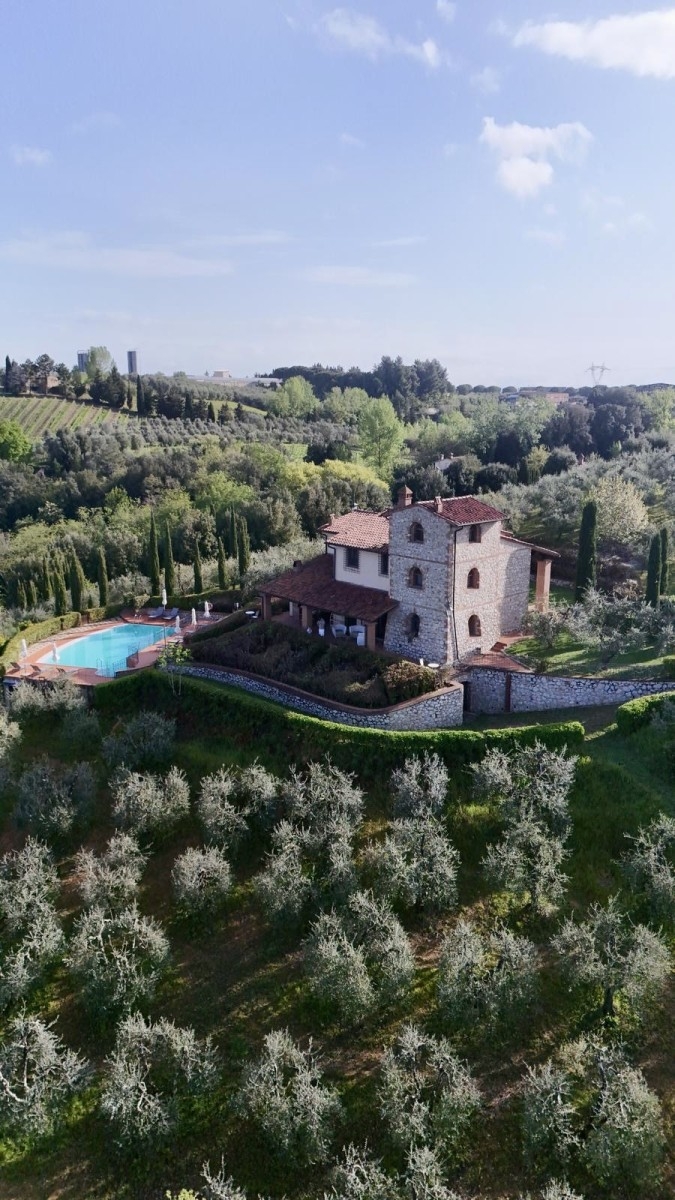
The electric gates open slowly, as if they are in no hurry. Beyond them, a gravel track winds upward through the hillside, the stones announcing each tyre rotation with a satisfying crunch. On either side, olive trees lean into the late-afternoon light, their silver-green leaves bouncing off the rays. Opposite, a vineyard unfurls along the slope in neat, patient rows.
By the time we reached the hilltop farmhouse, Tuscany had laid itself out beneath us like an offering. And at the centre of it all, an ancient tower – the original heart around which the house had been built over the centuries. Once home to a noble Tuscan family, the lookout tower was once part of an ancient fortified heritage.
Overlooking the valley offered a quiet luxury – a view entirely ours. From this height, the world becomes a breath held still – no wind disturbs the trees, no sound travels up through the layered air. The light settles into the rolling folds of the land, and the distant Alps wear their shadows like backdrop of a Renaissance painting. Everything rests in its own silence apart from the birds singing all around you. Although they are not visible, as if they, too, are respecting the stillness of the moment.


To stand on that hillside was to understand, properly, what the Italians mean by
‘dolce far niente’ – the sweetness of doing nothing.
A very deliberate, very conscious choosing to simply be. For a 50th birthday, there could have been noise and fanfare. Instead, I had chosen this: silence, space, and the company of people we loved. It felt like the right kind of celebration.
When life moves this gently, it becomes indistinguishable from silence; it’s an opportunity to leave behind the busy commute and the daily political drama. Your thoughts soften. And standing on the terrace, for a while, no one said anything. Modern life receded to an abstraction. The things that had felt urgent two days ago now seemed to belong to another person, another landscape entirely.
The farmhouse had two personalities it leaned into. Outside, it lived in full conversation with the landscape. A long carrara marble table sat on the terrace at its centre – cool to the touch, solid, beautiful, worn smooth and honest with use. This became our gathering place. A family breakfast full of flowers, cooked food and pastries drifted into mid-morning coffee. Lunch unhurried. Evenings unfolded slowly, with the kind of ease that only happens when no one has anywhere else to be.


We made pizza on the barbecue – an ordinary, unexpected joy. The char and smoke, the family together, decorating the pizzas, the collapse of a too-generous topping, the particular pleasure of cutting something imperfect and sharing it with people you love. Exactly right for the moment.
The bird life accompanied it all. From the terrace, you could close your eyes and simply listen: the clean two-note call of a cuckoo somewhere across the valley; a robin and a blackbird taking turns in the olive trees; the occasional madrigal of a blackcap. All keeping themselves discreetly tucked away. Until a hoopoe, with its extraordinary salmon-pink plumage and absurd crest, decided to greet us on the gravel drive.
The private pool was a feature of the house. Far too cold in springtime, but an obligatory swim livened the senses. A coffee and cantuccini – those hard, twice-baked almond biscuits – helped the defrost. Although Italy taught me to reserve a few to dunk into the dessert wine. I’d clearly been misusing them for years.


Step through the front door, and the atmosphere changes entirely. Where the terrace was open and full of sky, the interior was cool, dark, enveloping. Thick oak beams crossed the ceilings. Tan leather sofas held their shape in the low lamplight. Pools of warm light fell on framed pictures, spotlit, deliberate, like a private gallery. A country kitchen anchored the ground floor, smelling of stone and good olive oil.
Below, in the cellar, a games room waited. We descended into its stone depths one evening after dinner to play French billiards with a few drinks from the bar. Our laughter echoed off the walls in a way that felt entirely appropriate for a room underground.
On our first evening, someone suggested lighting the fire. The large stone fireplace dominated one wall, magnificent and inviting in the colder evenings. We laid the wood carefully, lit it with confidence, and stood back to admire the effort. Although no one realised you had to open the flue.
The smoke arrived swiftly and democratically, filling every room with the warm, unmistakable scent of a bonfire. The house had absorbed the smell entirely, wearing it for the rest of our stay like a second identity. For days afterwards, every room held the faint ghost of woodsmoke – a memory made tangible. It became the scent I carried home.
Truffle Hunting in Tuscany
One morning, we left the hilltop and went deeper into the Tuscan countryside for a truffle hunt. Our guide moved through the trees with the particular quiet authority of someone who has been doing this for a long time, reading the ground with the kind of knowledge that accumulates over a lifetime and cannot be taught in an afternoon.


We were accompanied by two dogs. Maya hunts, her nose low, moving in wide, deliberate arcs, reading something in the air and soil that is entirely invisible to us. Bibi digs, called in when Maya has done her work, pawing at the earth with focused urgency. They operate as a team, desperately keen to make their owner happy and earn a treat.
A truffle takes around two months to grow, and competition and climate change are making each season harder: the truffles themselves are getting smaller, the yields less certain. Wild boar compete in these same woods, rooting up the ground. Other hunters work the same trails.
A found truffle, rich and earthy, is good for perhaps seven to ten days. If you are lucky, you could find a white truffle. These are only found in Tuscany and Croatia, from October to December.
As we walked through the dappled countryside, littered with small pink flowers, our guide pointed out a series of shallow depressions in the earth. “Old hiding holes,” he said quietly.
During the war, his father and a group of ten or so friends had sheltered here for a year, in this very forest, to escape persecution. They lived in holes beneath the ancient oaks, amongst the roots, waiting. Waiting for the war to end. Waiting to be safe enough to leave.
My retreat from the world was suddenly interrupted. The realisation that war had reached even these woods – which had felt a million miles from the world’s noise – was a reminder of how recent, how vivid, and how close European conflict actually is. The image of ten young adults, the age of my son, living out here in the darkness, in these earth hollows, patiently enduring while the world raged above was haunting.
I thought of mothers, too. Mothers who visited these holes in the dark, carrying food through the trees, risking everything to keep their sons alive. The thought of it – the ordinary, extraordinary courage it demanded – stopped me where I stood.
We had spent the week retreating from the noise of the world, the endless, exhausting churn of political tension that had followed us from home. And here, in these woods, we had found a reminder of what true refuge once meant. The hills had not just been beautiful. For some, they had been the difference between safety and something worse. Between life and unimaginable loss.
I hope we never have to return to that reality. But today’s world seems closer than ever to those dark edges. The truffle forest held its silence differently after that – not peaceful, but weighted with the knowledge of what silence once meant to the people who hid beneath these trees.
We came back to the farmhouse with a pot of truffle honey and something heavier and more complicated than we’d left with. That evening, the truffle honey was slathered on Italian cheese paired with wine, and we ate on the terrace while the swallows flew their nightly circuits above the vineyard.
A Trip to Volterra
Volterra itself arrived with drama. The city sits at nearly 550 metres above the surrounding valley, perched on a rocky plateau with the assurance of something that has never once doubted its own importance. You see it from a distance long before you arrive, its towers and rooflines rising against the sky like a stage set, except it’s undeniably real.


Up close, it is all cobblestones and shadow. Medieval streets are so narrow that the light barely reaches the ground. Alabaster workshops where craftsmen have been working the same pale stone for centuries. Those with a certain fondness for gothic fiction will recognise it as Volterra from the Twilight saga – the ancient seat of the Volturi, rulers of the vampire world.
Standing in the main piazza, with its medieval tower casting a long, cold shadow across the cobblestones, it is not difficult to see why it was chosen. There is something timeless and slightly unsettling about the place – a city that has watched centuries pass from its hilltop perch and has changed remarkably little. The locals move through these streets with the ease of people who have always belonged here. The rest of us are simply passing through, stopping for a coffee and borrowing a moment of its ancient certainty.
A Celebration
On our final night, Simone arrived at the house with her sister. Together they moved into the country kitchen with the quiet efficiency of people who have cooked together for a long time – no fuss, just the low sounds of preparation drifting out to where we sat on the terrace as the light changed.
The table was laid with an antique lace tablecloth, an heirloom designed to fit the large wooden dining table to its exact size. The effort the chefs put in laying the table and cooking was heartwarming. From the terrace, the smells drifted out; something wonderful was happening in the kitchen, and we were lucky enough to be the ones trying it out. Glasses of Prosecco arrived first on the terrace, cold and unhurried.


When we sat down to eat, the table held everything the week had been moving toward. It began with a seasonal vegetable flan with pecorino fondue, alongside a board of Tuscan cured meats and croutons that tasted of the region in a way that no supermarket version ever quite manages.
Then fresh pasta with a pesto of Tuscan black cabbage: earthy, deeply green, intensely local. The main course was a steak prepared all’antica – marinated in Tuscan spices, baked slowly with tomatoes, peppers, and rosemary until the kitchen smelled like an Italian grandmother’s Sunday. A Chianti red came with it, full and unhurried. We ate slowly. We talked. The candles burned down.
Then, the final course, the chef baked a gorgeous strawberry and cream birthday cake, and served it with strawberry Fragolino dessert wine. It was a wonderful surprise and a lovely way to finish the meal.
The Slow Life in Tuscany
There are trips you take to see things. And then there are trips where the seeing is almost incidental, where what you’re really doing is being somewhere, together, in a way that asks very little and gives back an enormous amount.
The gravel drive on the way out sounded the same as it had on the way in. But we were quieter on the descent. The olive trees held their silver-grey colour all the way to the gates. And then the gates closed behind us.
What we carried from Tuscany was the memory of what it feels like when time stops asking anything of you. The knowledge that such places exist, and that rest is possible. We carried the laughter from that final evening, the taste of that perfect meal, the bonfire-soaked clothes and the morning sound of peace with its birdsong.
And yes, woven through it all, the harder knowledge of what refuge once meant, what it might mean again. The sweetness and the weight both belong to what we carried.
The Tuscan landscape will stay in our minds long after the gates closed. In fifty years, I have learned that the best celebrations don’t announce themselves. They unfold quietly, with good people, good food, and the kind of time that lets you simply be. In those moments when the world grows loud again, we have this: the memory of silence, and all that it held.
For more of Italy’s slower pleasures, the Cinque Terre offers a very different kind of stillness — five cliff-side villages negotiating with the land, and the sea. Or, for Italy at its most physically demanding, read about cycling the Dolomites to Venice.


Leave your thoughts