

Salvador Dalí
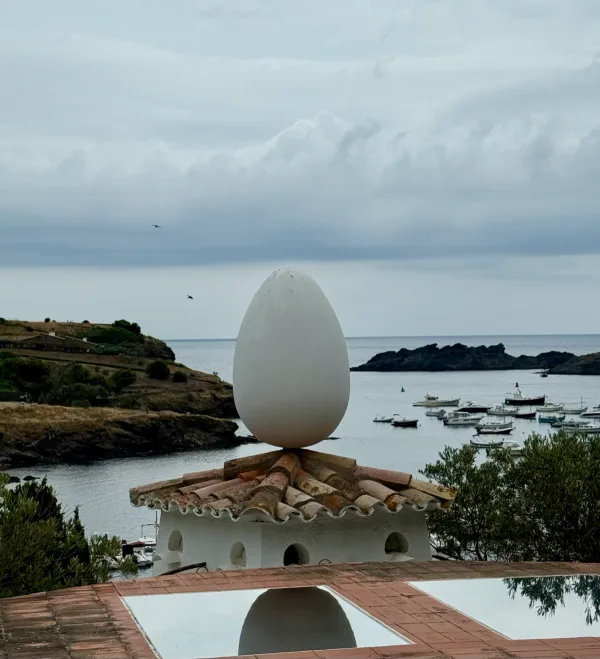
Salvador Dalí lived in Portlligat, Catalonia. His house clings to the rocky coast where the Pyrenees meet the Mediterranean. His theatre-style museum is also in this region, in Figueres. It functions as a three-dimensional self-portrait. Visiting these spaces is an amazing insight into the artist’s subconscious, where polar bears wear medallions, swans perch with theatrical poise, and the line between reality and dream dissolves entirely. This isn’t conventional art tourism; it’s a pilgrimage to the landscape that shaped surrealism’s most flamboyant genius.


The Journey: Mountains, Storm, and Expectation
Approaching El Peni
The pilgrimage to Portlligat begins with a test of nerve. The road from the Baix Empordà region to Cadaqués climbs El Peni, clinging to the mountainside as it corkscrews upward. I hadn’t paid much attention to the steepness until we reached six hundred meters, and I glanced down at the dizzying drop.
My hands began sweating on the steering wheel. My fear of heights bloomed like an uninvited intruder. Then a local woman zoomed past on a moped, sundress billowing, sandals tapping lightly on pedals as if she were gliding through a park. I felt both envy for her effortless grace and slight irritation at my own anxiety.
The descent into Cadaqués released the tension. The charming village sprang forth in striking white, embraced by the sea, a place cherished not just by locals but by Dalí, Picasso, and Matisse. The anxious flutter settled. It became clear why Dalí chose this enchanting enclave, even if accessing it felt like a dramatic entrance.
Cadaqués: The White Village
Cadaqués presents itself as Mediterranean perfection: white houses tumbling down hillsides to a rocky bay, narrow streets designed for donkeys rather than cars, church bell towers catching light against blue sky. The village has maintained its character despite art-world fame, somehow remaining authentically itself while accommodating pilgrims to Dalí’s shrine.
But there’s something else here, a quality of light that attracted modernist painters like moths to flame. It’s sharp, clear, almost hallucinatory in its intensity. Shadows are absolute. Colours vibrate. Standing in Cadaqués, you understand why Dalí painted with such meticulous detail; this light demands it.
Dalí’s House in Portlligat: The Magician’s Lair
The Polar Bear’s Welcome


Visiting Dalí’s house felt like stepping into a magician’s lair tucked beside the sea, a space blurring the line between eccentricity and genius.
The moment I stepped through the front door, a life-sized polar bear greeted me, proudly draped in medallion chains, casually standing guard beside a shotgun and a collection of Dalí’s walking sticks. This wild welcome was a gift from Edward James, the eccentric English poet and patron who supported Dalí’s surrealism.
There’s no easing into Dalí’s world. You’re thrust immediately into theatrical absurdity that somehow feels perfectly logical within its own universe.
Reading the Swans
Above the sitting area, three taxidermy swans perch with theatrical poise. I didn’t give them much thought initially. But as the day unfolded, I realised swans quietly echo through Dalí’s work – symbols of fragility and beauty.
In Dalí’s visual language, repetition always signals meaning. These swans weren’t random decoration; they were recurring characters in his personal mythology.
The Bedroom: Sunrise Ambitions
The room that stayed with me most was his bedroom, arranged like a stage set. A mirror was positioned perfectly to catch the sunrise. Dalí’s ambition? To be the first Spaniard each day to see the morning light.
I made a mental note to try this sunrise trick at home if I don’t achieve my dream of a house with sunset views first.
More unusual was the cricket in a box kept by his bedside. Dalí loved the repetitive chirp of crickets rubbing wings together. Where others might find it maddening, he found it soothing, the kind of detail that reveals more about creative psychology than any biography.
The Studio: Where Dreams Were Manufactured
Walking through his studio felt like peeking backstage into his mind. Whitewashed walls, natural light pouring through large windows, and a wooden frame rigged on pulleys that allowed canvases to glide up and down through the floor. He would paint seated, the canvas moving to meet his brush.
It was practical but also theatrical – very Dalí. Why stand and reach when you can engineer a system that brings the work to you? The studio reveals his working method: meticulous, controlled, surprisingly methodical for someone associated with unconscious dream imagery.
The Acoustic Room and Celebrity Wardrobe
Hidden next to the dressing room, filled with celebrity photos like trophies, lies an acoustic room. Standing dead centre under the domed ceiling, your voice reverberates as if amplified through a microphone. Dalí reportedly used this for dramatic effect when receiving visitors, positioning himself at the sweet spot to make pronouncements that seemed to come from everywhere at once.
The house itself winds and twists like a warren, growing organically over time as Dalí bought neighbouring fishermen’s cottages and stitched them together. Walking through it feels like navigating someone’s stream of consciousness.
The Pool: Theatre by the Sea


The garden spills over rooftops, broken into terraces with sweeping views of the sea. But the pool area is where drama peaks. A lip-shaped sofa inspired by Mae West’s mouth sits boldly centre stage, flanked by Pirelli tyres. Wooden animals, life-size lions, and a large material snake wrapped around a pergola watch the pool area like audience members at a performance. This wasn’t designed for swimming; it was designed for photographing and hosting.
The Storm Approaches
Our time at Dalí’s house was fleeting. Phones chimed simultaneously with weather alerts: an intense storm bearing down, coastal areas to be avoided. Urgency coursed through me as we retreated toward those serpentine mountain roads – yes, that daunting path again, heart racing, hoping to evade the impending downpour.
We had a choice: return to the hotel or push on to Dalí’s museum in Figueres. After missing our earlier time slot, we decided to book new tickets. A museum could be the perfect escape on a stormy Saturday afternoon.
Figueres: Dalí Theatre-Museum


Arriving Soaked
We parked at the town’s edge and set off for a twenty-minute walk. Barely five minutes in, the skies opened in torrential downpour. We dashed between doorways and sheltered shopfronts, laughing despite frustration and absurdity.
Finally, dripping but grinning, we arrived. A quick session under the museum’s hand dryers gave me an impromptu 80s shag cut. Then we stepped into Dalí’s surreal universe. It was worth every soaked stride.
Not a Museum – A Theatre
This isn’t your typical museum. Dalí didn’t just exhibit here; he designed the entire space as a theatrical masterpiece. It feels like stepping into a subconscious realm, unlocking hallucinatory elements without drugs. As Dalí put it, he wanted to “make the Empordà region a universal place through the Dalí Theatre-Museum.”
You feel that ambition in every room. The central courtyard features a Cadillac installation, overlooked by rows of gold-coloured mannequins adorning the old Municipal Theatre’s walls. A surreal geodesic dome crowns the former stage. It’s pure spectacle, architecture as showmanship, museum as performance.
The Subjectivity of Looking

One thing I love most about this museum: its subjectivity. The more you look, the more you see. Then you realise you missed half of it the first time. It’s a place that rewards curiosity and punishes assumptions.
Take Gala Nude Looking at the Sea, Which at 18 Meters Appears to Be President Lincoln. First time I passed it, I saw Gala – serene, singular. Over an hour later, from a different angle across the museum, Lincoln revealed himself.
Dalí was a master of visual trickery, reminding us that meaning can shift. Look, look again, then look once more.
Labyrinth: Portal to the Subconscious

In the same room stands Labyrinth, a striking piece created for ballet at the Metropolitan Opera House in 1941. It dominates the stage like an oversized portal to Dalí’s subconscious. You glimpse references to Cap de Creus peeking through the breast-shaped opening in the scenery.
This piece demonstrates Dalí’s interdisciplinary genius. He didn’t just paint; he designed sets, created films, and collaborated with dancers and musicians. The theatre-museum format suited him perfectly because his art was always theatrical, always performing.
Dalí vs Picasso: The Fishmonger’s Room


In the Fishmonger’s Room, I lingered on two self-portraits: Dalí and Picasso facing off. At first, it feels like rivalry. But Dalí admired Picasso deeply.
In his portrait, Picasso is depicted as an emperor, surrounded by symbols – carnations, goat horns, and a mandolin. All references to intellectualism, superiority, and sentimentality. Dalí’s self-portrait is softened, slumped over crutches with a slice of bacon perched on it, a nod to his everyday breakfast and his surrealist belief that even the mundane could be magnificent.
This pairing reveals Dalí’s self-awareness. He knew he was the showman while Picasso was the revolutionary. But he also understood that showmanship is its own form of revolution, making art accessible, entertaining, and impossible to ignore.
Galatea of the Spheres: Atomic Love

Then there’s Galatea of the Spheres (1952). Gala, Dalí’s muse, fragmented into perfect atomic orbs suspended in space.
Lately, I’ve been thinking about how we’re all stardust, atoms waiting to rejoin the universe. This piece hit that chord beautifully. A quiet reminder that we are more, and less, than what we appear to be.
Dalí painted this during his “nuclear mysticism” phase, influenced by atomic physics and quantum mechanics. He saw connections between contemporary science and classical mysticism, between the material and the transcendent. Gala becomes both flesh and fundamental particles, love rendered as atomic structure.
The Storm as Finale
Driving into Theatre
Departing just after sunset, the twilight sky transitioned to deep blue and dark lavender flecked with rose. Content with the day’s adventures, we set course back on the C-66.
The motorway lay quiet as the night deepened to indigo blue. Rain returned, and the rental car’s wipers struggled against the deluge.
Then nature’s curtain call: the storm made its dramatic entrance. Forked lightning lit up the horizon in bursts of pink and orange, thunder rumbling like distant applause. It wasn’t just a tempest; it was an hour-long performance, a grand finale to a day steeped in art, thrill, and enchantment.
Some might label it sightseeing in a storm. I call it a spiritual recital, a day woven with beauty, fear, surprises, and wonder that will linger forever in memory.
Catalonia’s art doesn’t end with Dalí. Barcelona is an hour away, where another visionary transformed a city into a living gallery — read the guide to Barcelona’s Gaudí masterpieces. And for the food and landscapes that surrounded Dalí’s Portlligat, the Catalonia food guide covers the coastal cuisine of Baix Empordà, the region he called home.
Leave your thoughts