

Porto doesn’t try to seduce you. It stands proud – granite-dark, weather-worn, leaning into its age. Then, mid-street, it ambushes you: a building erupts in azulejos, hand-painted tiles spilling from rooftop to pavement in blue and white telling historic tales, or bright yellow and white daisies blooming across the facade. It’s a city that carries its past openly – its port wine, cork and salt cod as unchanged as the cobblestone roads. And yet, down the next alley, a speciality coffee house, a gallery, a design studio doing something quietly new.
Rua do Almada
The electric motor whines to a halt, and the taxi door swings open, letting in the warm air, tainted by a mineral scent. Porto greets me in a narrow street of 19th-century bourgeois architecture. Rua do Almada runs for about half a mile to the city’s heart and was one of the first streets built beyond the medieval walls. The buildings are tall, slender and pressed together like books on an overflowing shelf. Porto’s industrial granite dominates the facades, with paired windows rising over three or four floors. The road is worn and weathered. Some buildings have been lovingly refurbished; others have tiles clinging to their decay like memories that refuse to be demolished. This was once a working street – home to haberdashers, ironmongers, and small pharmacies with hand-lettered signs. Today, it houses independent hotels and chic coffee houses. The taxi driver helps me with my bags to the cobalt blue doors. They swing open, and a Portuguese man welcomes me to the start of my Porto adventure.
Hunting Porto’s art and azulejo tiles
After settling into my room with floor-to-ceiling windows, wooden shutters, and a small balcony overlooking the street, I decided to wander to take in the architecture and art.


Azulejo tiles are woven into Porto’s character – weatherproofing the buildings from the salty Atlantic air while telling the city’s story across every available surface. Most of the famous landmarks are coated in them, as are the neighbourhood facades.
São Bento train station


My walk started at São Bento train station near my apartment. The hall is lined with more than 20,000 blue-and-white tiles painted by artist Jorge Colaço and completed in 1916. Most people pass through with a train to catch on their minds, but slow down and spend a few minutes here, and Portuguese history unfurls across the walls – medieval battles, royal processions, and scenes of rural life, each tile capturing a moment frozen in time.
Saint Ildefonso and the Chapel of Souls


From the station, it’s a short walk uphill to the church of Saint Ildefonso. The entire exterior is covered in 11,000 narrative tiles, also by Jorge Colaço, applied in 1932, depicting biblical scenes in blue and white. The sky that day was as blue as the tiles themselves, and the effect was one of near-dissolving: building and sky merging into one seamless canvas of indigo and white, the boundaries blurred.
Around the corner, the Chapel of Souls is equally draped, its facade depicting the lives of saints in exquisite detail. Step back far enough, and the building becomes a giant altarpiece, open to the street.
Porto Cathedral
Outside, the Cathedral presents itself as an imposing fortress, with a terrace offering sweeping views over the city and the Douro River. But step inside, and the gothic cloisters reveal something more intimate – walls lined floor to ceiling in azulejo panels of hunting scenes, mythological figures and pastoral scenery.


Walking down Rua das Flores toward the river, I came across Liqen’s Blue Cat tucked into an alley – a giant mural of a city cat painted in the same blues as the azulejo tiles. It’s so large that it’s impossible to take in properly up close; you need to step back, tilt your head, and let it settle.


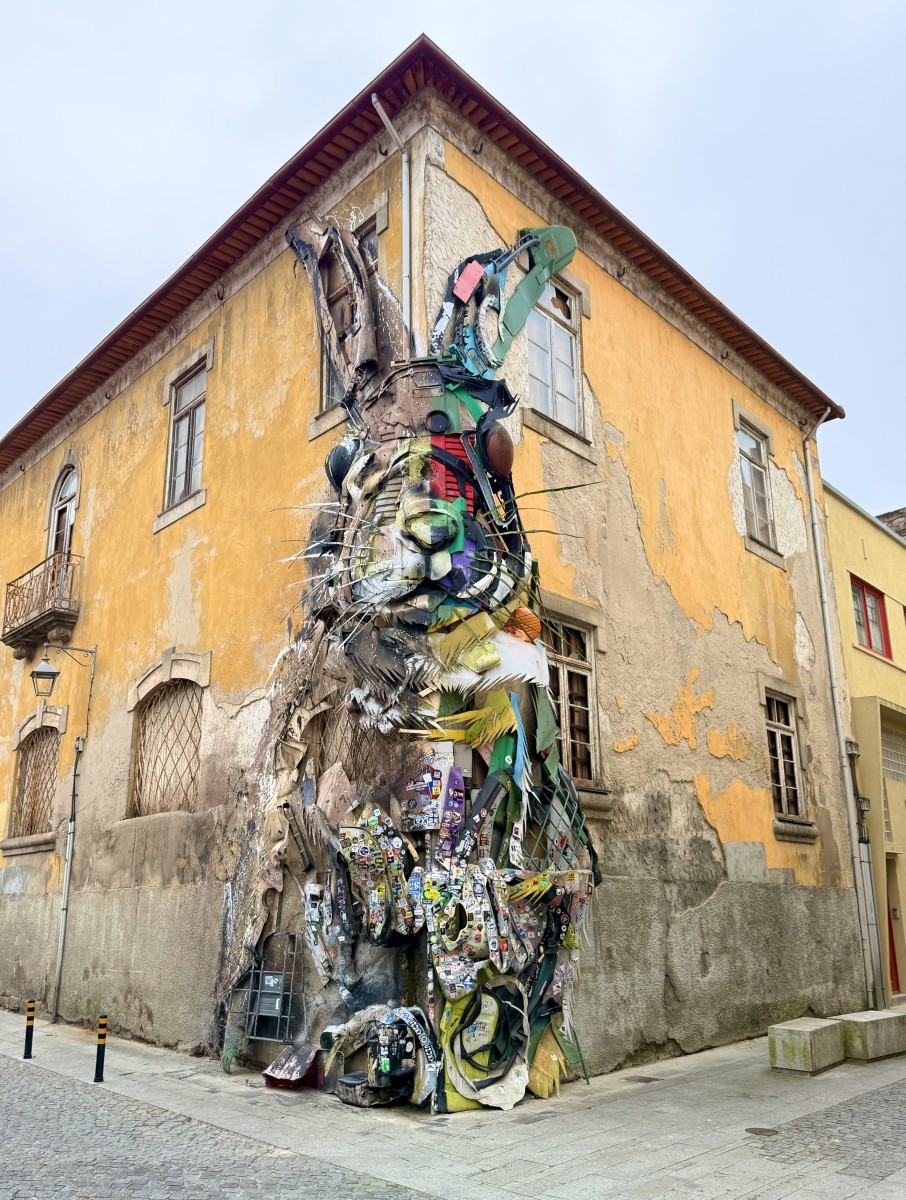
Wandering across to Vila Nova de Gaia, I found the giant Half Rabbit by Bordalo II on the corner of a building, assembled from industrial waste and recycled materials. Part sculpture, part environmental statement. It was my favourite find.
Livraria Lello – one of the most beautiful bookshops in the world
The next day, my wandering took me to Livraria Lello, named among the most beautiful bookshops in the world.


The Neo-Gothic facade gives little away. But step through the doors, and two curving wooden staircases rise from the ground floor and sweep upward to meet on a mezzanine, every inch of the carved wood a feat of craftsmanship – balustrades and arches worked into patterns that belong more in a cathedral than a bookshop. Above it all, a stained glass ceiling floods the room with coloured light, casting soft pools of amber and green across the shelves below.
I ran a hand along the shelves, watching the light shift through the glass. It felt important, somehow, to leave with the right book – something Portuguese, something that belonged to this city.
I chose Blindness by José Saramago. Portugal’s only Nobel laureate in literature wrote with a long, rolling, relentless prose that mirrors the disorientation of his subject – a city gripped by an epidemic of sudden, inexplicable blindness. I carried it two minutes up the road to the Hungry Biker café on Rua do Almada – the street I’d been staying on all weekend, and ordered lunch. They’re known for their savoury waffles and pancakes, which didn’t disappoint. It was a perfect stop to slow down from the city.
Mercado do Bolhão
The market has been a fixture of Porto’s daily life since 1915 – its name, supposedly, from the bolhão, the “big bubble” of a stream that once ran beneath this patch of ground. After years of decay and a long-awaited restoration, it reopened in 2022 with all its original bones intact: a neoclassical two-storey hall built around an open courtyard, flooded with light, the upper gallery ringed with iron railings and trailing greenery.
Inside, the stalls are stacked with the Atlantic’s catch – salted cod, gleaming shellfish, fish that were in the sea this morning. Around them, wheels of cheese, ropes of chouriço, jars of olive oil the colour of new grass and baskets of fruit. Florists, bakers, producers who’ve been trading here for generations.
On the lower level, tucked into the corners where the market meets the street, are wine bars pouring glasses of Portuguese red and white to anyone who wants one, which, by mid-afternoon, appeared to be everyone! I tasted my way through small plates of cheese, slices of cured meat, and pastéis de nata, still warm, walking from stall to stall with a glass of white in hand, feeling like I’d stumbled onto exactly the right way to spend an afternoon.
Aveiro – the Venice of Portugal
An hour south of Porto by train, Aveiro wears the nickname “the Venice of Portugal.” The town is threaded by canals fed by the Ria de Aveiro lagoon, where flat-bottomed moliceiro boats glide past Art Nouveau townhouses painted in shades of butter yellow and dusty rose.


You can’t visit without taking a boat ride. Each boat’s prow is hand-painted, individually decorated – folk scenes on some, jokes on others; no two are the same. Floating through the canal, I was struck by the unexpected variety of the town’s architecture. Neoclassical buildings sit alongside art nouveau facades and modernist concrete, the whole thing strung together by waterways and bridge crossings. On the far canal bank, a local woman – intent on ignoring the tourists entirely – pegged her washing on a handmade line. It made me smile – this was her backyard, and no tourist was going to stop her drying her smalls on the river.
In the central market, locals still buy salt harvested from the lagoon’s ancient salinas, as they have done for centuries. Before leaving, try ovos moles – a traditional Aveiro sweet of silky egg yolk paste wrapped in wafer-thin shells, moulded into shell shapes. The original recipe came from the local nuns, who found a way to use up egg yolks with sugar. They are the most unexpected sweets I have tasted – somewhere between a Cadbury Creme Egg without the chocolate and something more refined.
Costa Nova – the coastal town with candy-striped houses
Costa Nova is a ten-minute drive from Aveiro and is worth visiting. The village is famous for its palheiros – candy-striped beach houses painted in bold vertical stripes of red and white, blue and white, green and white.


The tradition began with fishing families who used the distinctive patterns to identify their homes from out at sea. It worked then, and it still works now, though the audience has changed entirely. What once guided fishermen home through the fog today draws every camera-carrying visitor on the Aveiro day-trip circuit. I suspect residents have long made their peace with being perpetually admired.
The houses line a narrow strip of land between the lagoon and the Atlantic, and the contrast couldn’t be more complete. On one side, the calm, mirror-flat Ria; on the other, the full force of the ocean, wide and restless. The beach is long and sandy, backed by dunes, with the Atlantic unspooling beyond.
Vintage Tram to the Praia da Foz
Porto seems to have fully embraced electric travel, and one of the best ways to enjoy the city from Ribeira to Passeio Alegre is on Tram 1, a ride through Porto’s history. The yellow tram pulled up, and I boarded, instantly warming to the walnut wood and deep crimson leather seats. I took a spot on the left-hand side to keep the river in view. Chugging along the coast, a breeze floated through the vintage sash windows, broken only by the clang of the bell – operated on a pulley system that rings both ends of the tram. The carriage filled up quickly; those without seats clung to leather straps hanging from the ceiling.


From the tram stop, buildings stand guard along the shoreline in grey granite and concrete – raw, with derelict structures that haven’t yet decided their future. The area doesn’t invite you in immediately. But I continued to wander past the lighthouse and a couple of beaches, until something felt right.
A shaded pathway led me to a small beach that I instantly knew would befriend me. On the beach was a café with sunbeds. I was early and had my pick. Then I found it: a four-poster double bed on the beach, with a private view of the sea – as if it had been waiting for me to arrive. I kicked off my sandals and let the place settle around me.


The sea rolled in, arguing with itself. Chaotic waves dancing without rhythm, crashing against the rocks from three directions, their restless energy finding its final resting place and dissolving into white foam in the deep blue ink of the shallows. The Atlantic air tickled my face, strands of hair catching the wind, the four-poster’s sail flapping noisily. Wild, magnetic. I felt an instant connection to the place that had found me.
I planned to stay for the morning, but ended up staying for the entire day. I found pure contentment lying on the bed, watching the waves crash in, with a glass of champagne and tapas, abandoning plans to read or listen to music because the sea was more than enough. It made me think of Eurynome – the Greek goddess said to have arisen from Chaos and danced upon the waves at the birth of the world. The sea has always known something we are still learning. Only when the sky thickened to grey and the sun gave up shining did I finally leave, making a quiet pledge to return to this exact spot.
Ponte Luís I and Jardim do Morro
The Ponte Luís I is one of Porto’s great landmarks – a double-decked iron arch bridge designed by Théophile Seyrig, a disciple of Gustave Eiffel, completed in 1886. The upper deck, shared by pedestrians and the metro, sits some 60 metres above the Douro, and the views from the top are, by all accounts, extraordinary. I know this because I tried. I made about 50 yards before the height caught up with me – a tightness in the chest, shallow breath, a sudden and absolute certainty that I needed to turn around. So I did. I walked calmly back to the first café, ordered a pineapple mocktail, and considered my options. The solution arrived quickly: the train that crosses the bridge, one stop, eyes firmly half-closed. It still feels the right decision.
On the Vila Nova de Gaia side, the first restaurant I found had a DJ spinning a soft Ibiza-chill set. I took a high table overlooking the river and ordered dinner – and then, hoping to linger long enough for the sunset, ordered the chocolate and hazelnut cake too. I was too early. I ceded the table graciously to the queue of people waiting for a table and wandered behind the restaurant to the elevated park above.
Jardim do Morro is the kind of place that locals have quietly claimed as their own. The hillside was packed. A Jamaican group danced to reggae, competing gently with the DJ’s Ibiza tracks drifting up from below. A Chinese family sat cross-legged on wicker placemats, sharing a full family feast. Couples leaned into each other, eyes on the horizon. I settled onto the grass with my journal and, within minutes, was approached by four different people with crates of wine or beer to sell. The table service was better than anywhere I’d eaten all weekend.
Everyone was there with the same agenda: the sunset. The city turned orange and gold across the water, its cathedral and bridges lit by the last of the evening sun. Porto had kept its best view until last.
The tile tradition that defines Porto has its cousins elsewhere in the western Mediterranean. Seville’s Real Alcazar is lined with azulejo work that carries the same Moorish roots — intricate geometric patterns that arrived in the Iberian peninsula centuries before they became Porto’s signature. Further south, the zellige tilework of Marrakesh reveals the tradition at its North African source: hand-cut geometric tiles covering palaces, medersas, and riads in the same spirit of beauty made structural. If azulejos brought you to Porto, both cities reward that same instinct.


Leave your thoughts