

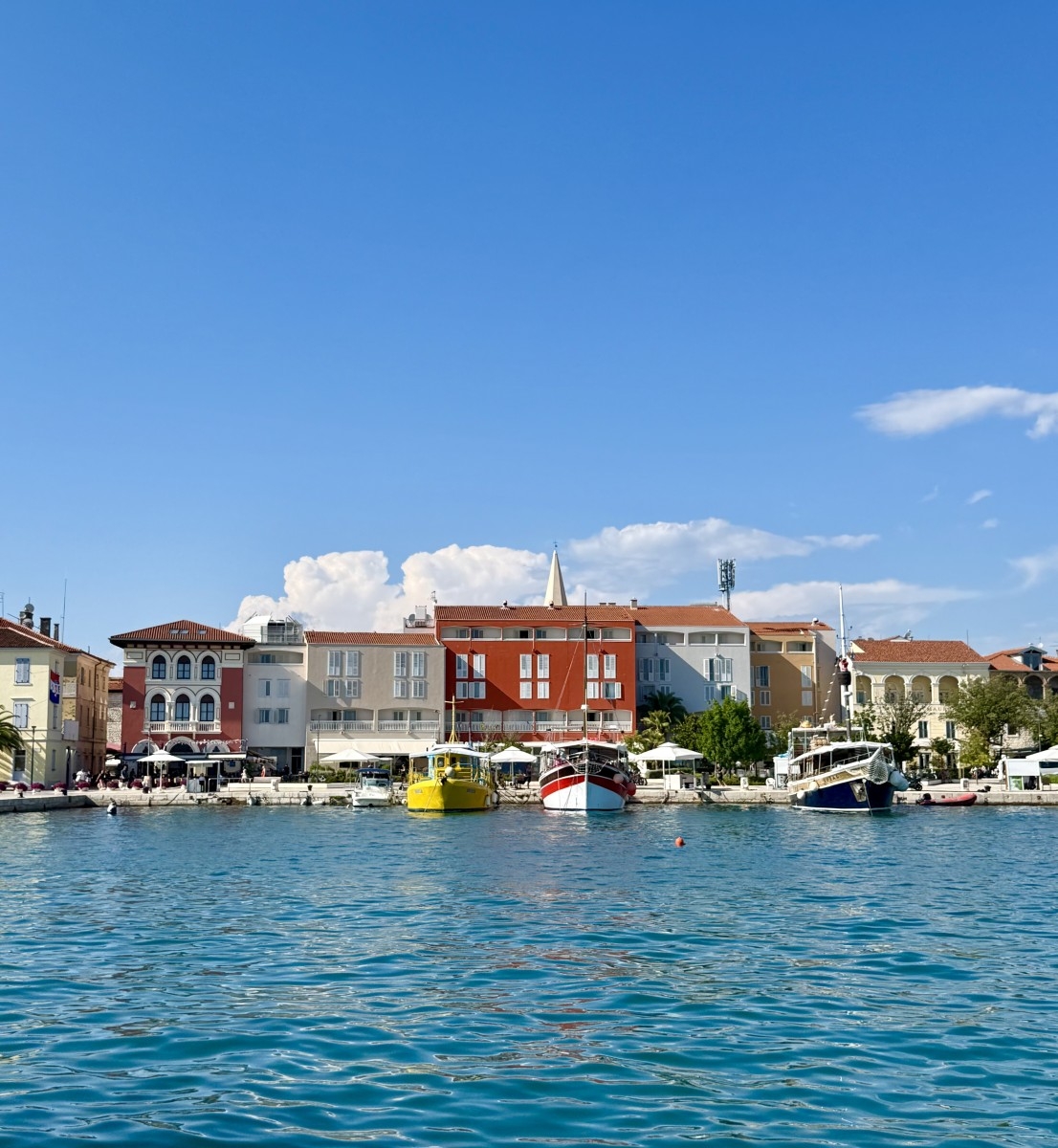
Seated on a wooden bench, swaying with the rhythm, catching the sun, I watch Poreč’s shoreline – it looks like a pretty, cosmopolitan fishing town. Yet, it holds Byzantine gold: mosaics crafted centuries ago sitting casually behind, with the rest of the history that the Romans left among the tourists like a secret in plain sight.
Rovinj, meanwhile, makes no attempt at secrecy. It’s romantic, artistic, and a little theatrical. The old Venetian fishing town has been dressed up with independent galleries, handmade ceramics and handicraft shops, fashionable sea-ledge bars on rocky coves and colourful courtyards, all waiting to be shown off on Instagram.
Poreč: history beneath your feet
Poreč is a town where every corner holds a piece of history, but it never feels like a museum.
Walking through the old town, the worn limestone cobbles are almost marble-like in the intense summer sun – their slippery surface reflects the light like the inside of an oyster shell.


Venetian buildings with Gothic-style windows, decorated with small balconies and shutters, overlook Poreč’s long and layered past. Remains from the 1st Century AD, such as the Temple of Neptune, sit amongst 13th-century Romanesque houses; Baroque palaces sit alongside the UNESCO World Heritage Euphrasian Basilica.


The extraordinary thing about the area is that all this history sits quietly on a narrow peninsula next to the sea. A tourist rests against a 1st-century stone tomb of Aurelia Rufina, whilst listening to the live music in the next-door bar. The finest surviving examples of early Byzantine art in the Mediterranean sit in the Basilica, allowing visitors to run their hands over centuries-old craftsmanship. There are no ropes, no guard moving people on. They should be protected, probably – but they are not, and that easy-going trust is part of Poreč’s charm.
Poreč is not simply a pretty Adriatic town waiting to be discovered by modern travellers. It has been an important place for centuries.
Life by the water
Mornings began with a gentle boat trip from the seafront to Isabella Island for the beaches, and the monastery’s infinity pool. Evenings ended with a crossing back to watch the sunset over the peninsula. Locals gather around the rocky shoreline to watch the sun go down. There is something wonderfully ordinary about watching people, often with their dogs in tow, begin or end their day with a swim in the Adriatic, as though the sea is simply another part of the daily routine.


Poreč has a food scene that feels increasingly ambitious. JAZ by Ana Roš, associated with the celebrated three-Michelin-star chef Ana Roš, has brought international culinary attention to the town. Spinaker’s secret weapon is Antonio, a dedicated mixologist who greets every guest with the offer of a bespoke cocktail – he designed me the best Vodka-Coffee I have ever had. And the new Harry Piccolo has already earned a Michelin Star. With the help of Valamar Group’s investment in the area, Poreč is shaking off its camping reputation, drawing superyachts to its waters and stepping quietly into five-star territory.
Rovinj: the pretty town

Rovinj feels as though it has been designed for wandering. Its old town rises up a hill, its narrow streets twisting between tall, tightly packed townhouses. The buildings were constructed close together because the old town was once a densely populated island. That density gives the streets a particular intimacy.


The architecture reflects Rovinj’s Venetian past, particularly in its older stone buildings and Venetian Gothic and Renaissance influences. But what makes the town feel so distinctive is colour. Terracotta, lemon and orange buildings sit beneath contrasting shutters. Old lanterns hang above narrow streets. Independent shops and bars embellish the outside of their buildings. A row of paintings hang outside on the brick wall of a bar, a mirror on a cafe wall, a courtyard is filled with colourful cushions. And then, occasionally, a candy-coloured Vespa appears, matching the colour of the building beside it.
Rovinj’s culture comes from fishing, seafaring, and agriculture, but the town’s beauty has attracted a newer, more creative community. Artists, makers, designers and independent businesses have added another layer to the old town.
The luxury of a hot afternoon
The heat was intense – the old stone buildings in the squares held onto it. Outside the bars and restaurants, mist fans worked overtime, throwing fine veils of cool water over anyone who lingered long enough to be caught by one. We spent much of the day wandering, stopping wherever we found somewhere cool enough to sit.

We then discovered the Revera tapas bar. This end of the town felt older, more weathered. The buildings rise from the sea, with battered wooden shutters keeping out the salty air, with pink flowers sprawling from them.
Escaping the intense heat, a table on the water’s edge under a shaded sail called to us. With bare feet resting under the table on the pebbles, the sea trickling in cooling my feet, a glass of wine in hand, watching a little boy dressed in a matching lemon-print combo, play with the Herring-gull, who was sizing its next meal – was everything I could have wanted.
Some moments etch themselves into your memory as perfect little snapshots of life. This was one of those moments.
A bar on the rocks
Later, we stopped at Mediterraneo, a small sea-ledge bar on a rocky inlet. Small wooden tables and chairs sat at the edge of the water. Colourful sails flapped in the breeze overhead, and cushions softened the rocks. People sat reading, drinking, and doing very little, just listening to the chilled beats and watching out to sea. Rovinj makes wandering and resting fashionably attractive.

St Euphemia and the story that washed ashore
At the top of the old town stands the Church of St Euphemia, one of Rovinj’s most recognisable landmarks. It is beautiful, but the story behind it is even better. According to legend, Euphemia was born around 290 AD. A devout Christian, she was arrested during the persecution of Christians under the Roman Emperor Diocletian. She was tortured and eventually thrown to the lions. But the lions killed her without devouring her.


Her body was eventually taken to Constantinople, where it was placed in a magnificent church built in her honour. Centuries later, around 800 AD, the Iconoclasts came to power and icons were removed from Christian churches. Then, somehow, the marble sarcophagus containing Euphemia disappeared. It later washed ashore near Rovinj. Nobody could move it. Until, according to the legend, a small boy arrived with two cows and managed to haul the sarcophagus up the hill. Today, St Euphemia is the patron saint of Rovinj. If you venture up to the church, you’ll be rewarded with beautiful views and the memorial to Euphemia.
The living colour of Rovinj
One of the most memorable experiences in Rovinj was learning more about its fishing heritage. Rovinj has some excellent restaurants; many have gained Michelin Stars. However, I wanted to visit an eatery connected to the land.
I visited the community project, Safeguarding the Living Colour of Rovinj, which celebrates the town’s cultural traditions and helps preserve its connection to the sea.


The evening started with a tour of the Batana Eco Museum, followed by a sunset cruise in a traditional batana boat. UNESCO has recognised Batana fishing traditions and skills as intangible cultural heritage, and the boats are an important part of Rovinj’s identity.
At sunset, two boats welcomed a couple of tourists, rowed by a fisherman. As we bobbed along in the gentle waters, a separate Batana boat carrying five more fishermen with musical instruments sailed beside us. They played and sang traditional songs as the evening light softened the buildings. The fishermen have a tradition of singing together that grew from their working lives. When they were hauling in nets, they couldn’t play instruments, so they began to imitate them instead. Some voices mimic the bass, others imitate the higher notes of instruments. The result is part singing and part orchestra, with the fishermen creating harmony by reproducing instrument sounds with their voices.
It is one of those traditions that makes sense only when you understand the circumstances from which it grew. They sang because they were working and were together. And eventually, the work songs became part of the town’s culture.
The experience was beautiful, but it was also deeply rooted in the town’s history. After circling the peninsula, the old town glowed as we approached the shoreline.
Fish, wine and a cool cellar
A helping hand out of the boat, and a short walk took us to an old wine cellar where fishermen once traded fish for wine.
It was cool inside. Large oak barrels lined the space opposite a dining table, while a small kitchen opened out onto the riverside. A seagull sat patiently on top of the fridge, waiting for its share of the evening’s catch.
We ate a four-course meal from the fisherman’s catch of the previous day: marinated sardines, tuna stew, fried shark, squid and white fish. Copious wine was served in glass tankards. The fishermen sang, and for a while, it was possible to imagine that the scene had changed very little over the centuries: the boats, the fish, the wine, the songs.
They finished singing with Bella Ciao – the same song the film Money Heist would borrow decades later. It became the tune my mind hummed for the rest of the holiday.
I was still humming it days later, back on the Poreč seafront, watching the morning swimmers. It struck me that the two towns carry the same inheritance in entirely different ways. Constantinople sent them both gold. Poreč keeps its share quietly in the apse of the Basilica, glittering above the visitors who wander in from the bars, unguarded. Rovinj’s arrived by sea – a marble sarcophagus nobody could move, until a boy and two cows hauled a saint to the top of the hill, where she has watched over the harbour ever since.
Two faces of the same coast. One wears its history lightly, the other wears it in colour. Travelling between the two, on a boat with the sun shining through the window, is exactly where I’d choose to be.
If you like art and are staying near Porec, read my blog about visiting Groznjan as it is worth a trip into the hillside to the village of artists. If you head that way, visit Stara Skola in Krasica for a gastronomic experience shaped together with Ana Roš.

Leave your thoughts