

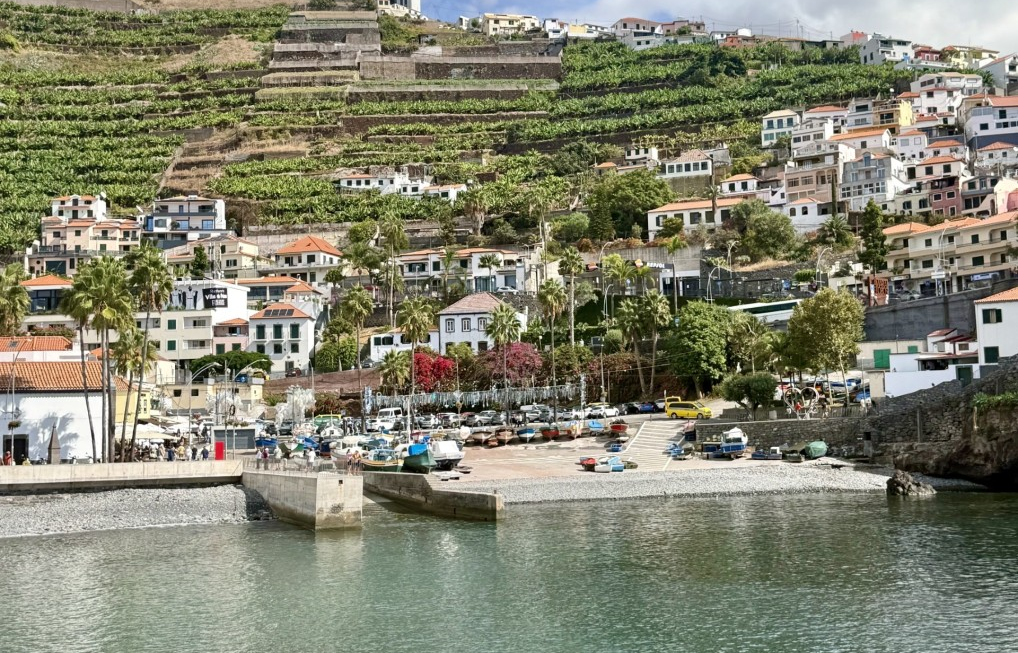
Câmara de Lobos is a fishing village folded into the cliffs west of Funchal. Banana terraces climb the hillside in green steps around the village, boats painted in a child’s paintbox palette crowd the marina, and the cobbled lanes are dressed in art made from recyclables that locals reuse from the Festas de São Pedro.
My taxi pulls over in the heart of the village centre, and I am instantly drawn to the colourful ribbons floating in the breeze overhead. It’s as if they are intentionally guiding you through the quiet centre – I start to wander.
I follow the route the village wants me to take until it ends at the stone sea wall with white swallows flying in its design. I rest my hands on the cool stone, look out across the bay, and notice a large artwork opposite, staring back at me.
From this distance, the outline resembles a seal. That makes sense, since the village is named after the seals that once crowded the bay. However, something about the art feels familiar. It’s a burst of blues, but the art looks textured, not like typical street art.

I follow the harbour around, and with each step the art comes into sharper focus. It’s a seal pup, made from plastic debris and a patchwork of salvaged scraps. Then I realise the design matches Bordalo II’s Giant Half Rabbit, which I found in Porto. Completely stunned, I step back and take it in, instantly feeling at home on this island in the middle of the ocean.
From here, I walk up to Ilhéu Gardens. My calves bite as I reflect on how lucky I am to find another one of Bordalo’s works. It tempts me to look up more destinations where his art lives. But stumbling across one in a tiny village so unexpectedly feels extra special.
The winding path guides me past small whitewashed houses, draped in bougainvillea in shades of magenta and plum. Potted snake plants sit proudly in colourful pots on doorsteps, and rosemary and lavender line the road.


Reaching the park, overlooking the village, olive trees shrug their silver leaves in the breeze. One of them is home to a canary who throws out a few bright notes. I lean on the wall wondering what kind of people live in such a beautiful village, just as a single, deep, deliberate bell rolls out from the church of São Sebastião below.
I notice the time on the church’s clock tower; it’s 12 o’clock, noon. A different bell joins the melody, overlapping and tumbling, as if it were daydreaming and trying to catch up. The sound spills over the rooftops, slips between the banana terraces, and drifts out over the harbour, where colourful fishing boats bob on the calm sea. The melody invites me to keep wandering, to visit the church that bathes the village in waves of sound.
Wedding preparations are beginning as I arrive; a group of women are tying flowers to the pews. I only manage to steal a few glances inside, but it is richly decorated in ornate gold with giant chandeliers and some amazing works of art.
The walk back into the centre continues to surprise me. Houses with masses of greenery sprout from windows and doors, adding to the village’s botanical feel. Large colourful pots line the paved streets filled with banana plants. Colourful art adorns the outside of the shops inviting you to take a closer look. That is when I notice each artwork is made from sweet wrappers or recyclables.


I hadn’t researched the village before I visited, but the more I saw, the more curious I became about its connection to art.
I find myself a high wooden stool and prop myself up at a table outside a bar in the centre with bright red parasols swinging overhead. Marco, the waiter, suggests a Brisa, a passionfruit cold drink that feels like the perfect choice for a sunny day.
I read that a local arts association has spent at least six months of the year collecting empty cans and plastic bottles since 2016. They clean and shape the waste into decorations for Festas de São Pedro – the feast of the fisherman’s patron saint.
Local people have adopted the art and made a greater effort to recycle their rubbish. One year, volunteers collected more than 25,000 empty cans from the village bars, which were transformed into some of the artworks I noticed on my walk.
Loud music broke my research as a moped puttered past. The rider was unhurried, wanting to be seen; it worked, everyone did. I’m curious to explore more of the area, especially after reading that a cliff top (580 meters high) behind Câmara de Lobos, houses a world-class glass skywalk – offering one of Europe’s most spectacular views of the village, ocean, and Funchal. But my time is limited, and the noisy moped nudges me away from my research and toward my way home. Next time I visit Madeira, I’ll return to this emerald enclave to spend more time here than a Sunday morning stroll.
Leave your thoughts