

A Guide to Marrakesh
Just three hours from the UK, Marrakesh pulses with an energy that quickens the blood and sharpens the senses. This is a city that doesn’t introduce itself with a whisper. It announces itself in waves of spice-scented air, chaotic narrow alleys, and the pink glow of terracotta walls. For artists, architects, and anyone who experiences the world through beauty, Marrakesh delivers a rare kind of intensity: every corner competes for your attention, history settles in beside you over a glass of mint tea, and the city’s disorder and artistry coexist with surprising ease.
The Colours of Marrakesh


Marrakesh wears one colour like a second skin. Every building, riad, and crumbling Medina wall is cloaked in pink terracotta sandstone. The city seems dipped in the glow of a setting sun. The hue shifts throughout the day: soft apricot by morning, deepening to copper by afternoon, then glowing like embers as evening settles over the Atlas Mountains.
The colour comes from the red earth, straw, and lime used in traditional construction. Local planning laws ensure no modern paint disrupts this timeless palette. But colour here extends beyond architecture. In the souks, a riot unfolds. Saffron-yellow slippers stack beside emerald zellige tiles. Fuchsia silk scarves drape over turquoise leather pouffes. Ruby-red tagines gleam next to cobalt teapots.
The Medina: Heart of Sensory Overload
Jemaa el-Fnaa Square
When you arrive, you’ll be drawn to Jemaa el Fnaa Square, Marrakesh’s cultural heart. Here you’ll find the souk, a labyrinth of stalls brimming with treasures. The area’s rich history dates back to the 11th century, when it served as a trading post for caravans bound for the Sahara. In the 19th century, the square hosted animal parks and festive horse races. The army assembled here and executed rebels. UNESCO designated it a cultural space on the List of Intangible Cultural Heritage of Humanity in 2001.
You will find all your senses heightened when you first arrive. The pungi flute’s hypnotic drone mingles with drum circles. These are meant to mesmerise humans as much as the cobras. The smell of mint battles with cumin, lavender, and the sharp tang of leather being worked in nearby workshops. Motorbikes thrust through crowds with alarming precision. Donkeys bray, and carts clatter over centuries-old stones. Stray cats bask in patches of sun. They are utterly unbothered by the chaos swirling around them.
At night, the square transforms. Storytellers draw circles of listeners. Gnaoua dancers spin to drumbeats. The air fills with smoke from grilling meat. Sweet orange juice vendors call out their prices. Everywhere, people are negotiating, laughing, and living loudly.
In the UK, we display our homes proudly from the street. Here, beauty hides behind high walls and weathered gates. A crumbling alley lined with pink-clay walls will suddenly open onto a riad courtyard. Fountains stand grand and orange trees bloom. This modesty feels like the city’s essential character.
The Souk: A Labyrinth of Treasures


The souk spreads like a living organism through the Medina’s veins. Narrow alleys twist without logic, opening occasionally onto small squares. Men sip mint tea and watch tourists lose their way. You don’t navigate the souk; you surrender to it.
Everything competes for attention. Carpets hang like tapestries in galleries. Brass lamps catch the afternoon light and scatter it in geometric patterns across walls. Leather babouches sit in towers organised by colour: twenty shades of yellow bleeding into orange, then red, then deep burgundy. The air itself tastes of coriander and cedar. Occasionally, the acrid smell of dye vats cuts through, where artisans still work skins by hand.
Architecture: Where Craftsmanship and Prayer Collide
Medersa Ben Youssef


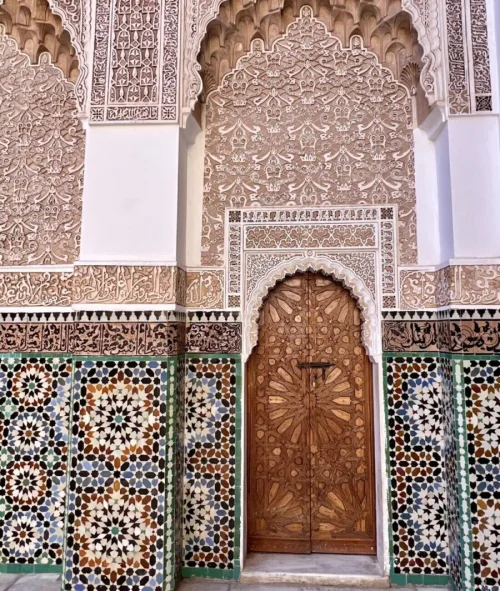
Step through an unassuming door in the souk and time collapses. Built between 1564 and 1565 by Sultan Abdullah Al-Ghaleb Assaadi, Ben Youssef Medersa was an Islamic learning centre where young men studied theology, philosophy, medicine, and mathematics for centuries.
Every surface including the walls, floors, ceilings, and columns is covered in intricate zellige tilework. Geometric patterns interlock with mathematical precision. Each tiny tile is cut and placed to form arabesques that draw the eye upward, then inward, then beyond. Cedar wood is carved into stalactite formations that hang from the ceiling like frozen honeycombs.
Light enters the central courtyard, illuminating dust motes and casting shifting, water-like shadows across the tiles. The space feels vast yet intimate, built to inspire awe and encourage contemplation.
El Badi Palace: Ruins That Still Command


Sultan Ahmad al-Mansour built El Badi Palace in 1578. It was a statement of Saadian power. Contemporary accounts describe it as an “enchantment for the eyes.” There was onyx of every colour, black and white marble, and column capitals covered in molten gold. Ceilings were encrusted with precious materials, and stucco work was so fine it resembled lace carved from stone.
Today, only ruins remain. Al-Mansour’s successors stripped the palace for materials to build mosques and other structures. This spread Saadian influence but gutted its original glory. In the vast courtyard, surrounded by towering walls, you sense the palace’s former grandeur. Remnants of tile patterns peek through centuries of weathering. Stork nests crown the highest points. The swimming pool that once reflected gold ceilings now reflects clouds.
The beauty here isn’t what remains – it’s what’s suggested by absence.
Dar el Bacha: Power Made Visible


Built in the early 20th century for Thami El Glaoui, the Pasha of Marrakesh during the French Protectorate, Dar el Bacha served as both a residence and a political theatre. El Glaoui, known as “The Lord of the Atlas,” entertained foreign diplomats, artists, and writers here, wielding soft power through architectural splendour.
Zellige tiles create intricate geometric gardens underfoot. Marble floors reflect carved cedar ceilings. Fountains create a focal point in courtyards planted with orange trees and roses. Every room demonstrates the fundamental principle of Moroccan design: symmetry, pattern, and craftsmanship elevated into an art form.
The palace now houses Bacha Coffee, an Instagram-famous café that’s almost too popular. Expect two-hour queues. The architecture justifies the wait, though hiring a guide lets you skip the line.
Gardens: Oases of Beauty
Le Jardin Secret


Four hundred years ago, during the Saadian Dynasty, Morocco’s political elite made this walled garden their home. In the mid-19th century, it was rebuilt. For years, its beauty remained hidden until restoration finally opened it to visitors.
Today, Le Jardin Secret offers respite from the souk’s sensory assault. The Exotic Garden was designed by British landscape architect Tom Stuart-Smith. It brings together plants from Africa, Asia, Australia, and the Americas. These are species that wouldn’t naturally coexist, but are united by design. The Islamic Garden follows a traditional four-part layout. Water channels divide the space into quadrants planted with olives, pomegranates, and orange trees. Their branches are heavy with fruit that glow against the pink walls.
A tower provides panoramic views over the Medina’s terracotta expanse. From this height, you see how the city spreads like an organic growth. There is no rigid grid of planned cities. Rooftops create an undulating landscape. Minarets punctuate the scene and mark time with the call to prayer.
If you visit, avoid weekends. The “secret” in the garden is out, and tourist crowds overwhelm the garden’s contemplative atmosphere.
Anima Gardens


Twenty-five minutes outside the city, against the backdrop of the Atlas Mountains, Austrian artist André Heller created something between a botanical garden and sculpture park. Anima spans 10,000 square meters of winding paths. Art appears at every turn. Works by Picasso, Keith Haring, Alexander Calder, and Rodin nestle among aloe, bamboo, palms, ferns, and vast cacti.
The garden invites slow movement. Hammocks hang between trees. Benches sit beside sculptures, offering places to rest and contemplate. A pond reflects the sky and mountains. Rosemary hedges release scent when brushed.
The rooftop café offers views of the Atlas range and its snow-capped peaks rising behind the garden’s lush greenery. It is a reminder of Morocco’s geographic drama.
Art: Contemporary art in an Ancient City
Monde des Arts de la Parure


I stumbled on this museum while walking to El Badi, drawn by its modern façade. Inside, you find over 3,000 pieces of antique jewellery, clothing, and textiles from fifty countries. The collection spans Africa to the Far East. It’s a private collection assembled over the course of decades.
But the building itself steals focus. Three floors of exhibition space culminate in a rooftop café surrounded by giant daisies and terracotta planters overflowing with succulents. Flowering vines attract butterflies and honeybees. It’s unexpectedly serene and the cleanest café I encountered in Marrakesh. A small hidden oasis.
Riad Yima: Hassan Hajjaj’s Gallery


Finding Riad Yima means navigating quiet, unassuming alleys where the pink walls look like every other passage in the Medina. You may need a guide to help you find it. Once through the door, the space explodes with colour. It’s a modern gallery that feels like the visual opposite of the ancient city outside.
Hassan Hajjaj is a local artist who’s gained international recognition with his “Moroccan street style.” His work explores the fluid boundaries of cultural identity. African, Arab, and European influences constantly shift and bleed into one another. Models wear traditional fabrics emblazoned with Nike and Louis Vuitton logos. This mix deliberately creates friction with Western perceptions of Islamic culture.


The riad contains a gallery, gift shop, and tearoom on the ground floor, with two more floors of artwork above. The rooftop offers bright striped seating on upside-down Coca-Cola crates—pop art meets Moroccan tradition. During my visit, I spent some time sipping chamomile and orange tea that tasted like liquid calm. By the time I left, I’d achieved the kind of peace usually reserved for meditation retreats.
Culture: The Theatre of Daily Life
Marrakesh doesn’t separate art from life. The call to prayer becomes music five times daily, echoing across rooftops. Carpet sellers perform rather than sell, unrolling rugs with flourish, telling stories about weavers and patterns and the grandmother who taught them the design. Bread bakers arrange their rounds in geometric patterns that mirror the zellige tiles in palaces.
The city operates on a rhythm that feels different from back home. Shops open when owners feel like it. Lunch extends into the afternoon. Time bends around tea breaks, prayers, and conversations that matter more than schedules.
Even negotiation becomes theatre. A shopkeeper offers tea. You decline. He insists. You sit. He names a price. You laugh. He clutches his heart. You counter. He pretends offence. Eventually, you agree on something in between, and the transaction concludes with genuine warmth on both sides. It’s a social ritual and a dance of connection in the marketplace.
The Lasting Impression
Marrakesh overwhelms, then rewards. The first day feels like sensory assault – too loud, too bright, too much happening simultaneously. You want space and feel the need to process the madness.
But something shifts. By the second day, you notice patterns in the chaos. The motorbikes that seemed reckless reveal precision. The aggressive sellers are just practising an ancient form of commerce. The call to prayer stops being noise and becomes a marker of time, structuring the day like the familiar sound of church bells on the hour.
You begin to understand the city’s intensity. Marrakesh teaches presence through sensory demand. You can’t be elsewhere mentally when the souk surrounds you with colour, scent, sound, and movement. You’re here, fully, or you’re lost.
The colours stay with you. After returning home, that particular shade of pink-terracotta glowing in the afternoon light creates a memorable warmth that makes you want to return.
For places to stay, read the most beautiful riads in Marrakesh blog.
Leave your thoughts