

Cycling the Dolomites
Nestled in the northern folds of Italy, the Dolomites rise like cathedral spires – etched with snow, piercing a silvery-blue sky. Below, a blanket of cloud drifts aimlessly, as if searching for home, swirling around the rich green tapestry of the mountains’ feet. The air here feels impossibly pure, as though this is where the Earth exhales before its breath carries across the world.
The landscape is so striking that it almost disguised the knot in my stomach, twisted tight like a cloth. Earlier that day, the transfer bus from Venice wound toward Dobbiaco over three long hours, and my mind whispered: It’s a long way to pedal back.
To quiet the nerves, I wandered through Dobbiaco. Cradled between the Tre Cime di Lavaredo and the Fanes-Sennes-Prags nature parks in the Alta Pusteria valley, exploring this sleepy village felt like a gentle way to start the journey.


The town centre is dotted with Tyrolean chalets, shops and cosy cafés. Buildings are pastel-coloured like the sweets on a child’s edible bracelet. In the heart of the cobbled square, the Parish Church of St. John the Baptist rises with quiet grandeur, its mint-green façade and clock-topped bell tower a gentle nod to the village’s alpine charm. Step inside, and the interior blooms with the artistry of Austrian painter, Franz Anton Ziller: ceiling frescoes unfold the life of St. John the Baptist in a palette of gilded golds, mossy greens, and dusky rose- tones that mirror the candy-coloured serenity of the world just beyond its doors.
Dobbiaco to Cortina d’Ampezzo
The next morning, after breakfast, we set off, guided by a GPS app and trailed by low clouds and mountain silhouettes. The cycling path began flat, winding beside grassy plains, slow and steady, with nothing to rush for, savouring the landscape.
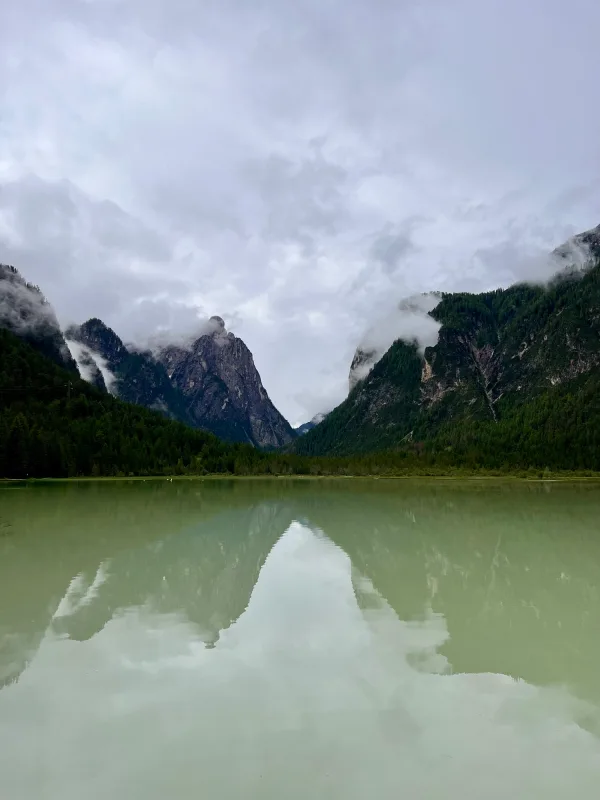
Soon, the path turned to white gravel, and the incline began to bite. Lactic acid burned like a silent scream in my thighs, and serenity slipped behind me like a forgotten postcard. But as doubt crept in, the path opened to the beauty of Lago di Dobbiaco – a lake of aquamarine green, framed by the Dolomites. The mountains cross, forming a perfect V, mirrored in the glassy water. A path of sunlight stretched through the opening, like an invitation to leap in. But at -1°C, with miles still ahead, I chose the wiser path: I kept pedalling.


Not long after, we arrived at the WWI Nasswand military cemetery, a solemn site where 1,259 soldiers lie in silence. It felt like a fitting resting place for those who had fought and fallen in the mountains, a poignant reminder of life’s fragility, and a moment of reflection on the sacrifices made in these rugged lands.
A few miles on, we reached a flooded river crossing. With no clear detour, I weighed the risk. The stream was fast-moving and knee-deep. As more cyclists arrived, we assessed the situation together. The consensus unanimous: no one would attempt the crossing. So we turned back, retraced our steps uphill, and followed a nearby highway for a short stretch until we re-joined the trail. I realised at this point the 200-mile journey was unlikely to be straightforward.
I pushed that thought aside and carried on, grateful for a flat cycle path that gave my legs a break. Soon, we entered a meadow bursting with yellow buttercups, each rising toward the sun like worshippers in prayer. In the distance, three snowcapped peaks – Little Peak, Big Peak, and Western Peak- stood, quietly watching us pass by.


A few more miles down the path, I slipped into the forest. Towering pine trees lined the trail, stretching their pine needles to the sky, competing with the mountains. The alpine air rich with the scent of moss and bark, and the deep, sonorous chime of cowbells echoed through the woods like nature’s hymn. It was the most amazing thirty minutes of my entire journey – as if the forest paused just long enough to let us feel its presence and pass through its magic.
From there, the route carved into the mountains. We entered a long, dark, cold tunnel where water dripped steadily from the ceiling, echoing like a bass-heavy track stripped of melody. A shallow stream splashed up the backs of my calves, leaving its mark as we pressed on through the shadows.
As we rolled into Cortina d’Ampezzo, the arrival felt like a quiet victory, tinged with the bittersweet weight of farewell. The thrill of completing the first leg of the journey was exciting, but I also felt the ache of leaving the Dolomites behind, their peaks fading further into the background as we moved forward.
Cortina d’Ampezzo is a world-class ski resort with world-class shopping, including Louis Vuitton, Gucci, and Dior. I wasn’t expecting such an array of stores and boutiques in an alpine village. It has a rich legacy of sport and style, having hosted the World Olympics in 1956, which is set to return here in 2026.
After a quick change and a wander, we sat out drinking a few wines on the piazza, enjoying the winter sun. We ended the evening early after a three-course meal in Il Vizietto – a cosy Italian seafood restaurant, reserving our energy for the following day.
Cortina d’Ampezzo to Belluno
The morning brought day two of the ride – an 80 km stretch that felt ambitious, especially given my limited time in the saddle. The route climbed steadily behind the village, offering a spectacular farewell to Cortina d’Ampezzo. We paused briefly to take in the sweeping view of the valley below, the town nestled like a postcard between the peaks, before joining the cycle track.


Not far along, we passed the downhill ski jump from the 1956 Winter Olympics – its towering frame rising from the landscape like a relic of a sporting legend, weathered but proud, still watching over the slopes it once dominated.
From here, we cycled through a string of charming Italian villages, each dotted with pastel-painted houses and bold contrasting shutters. We planned to stop for a break or lunch with every arrival, just as our guide suggested. But time and circumstance had other plans – some villages had shuttered their shops for the day, while others still bore the quiet scars of the pandemic, the recommended restaurants permanently closed and windows dark. So, we kept pedalling.
As we reached Longaraone, our cycle route was closed with a metal barrier and red tape laced across, warning people not to enter. There was no warning of this in the guide, and the alternative meant crossing the nearby state highway on a blind bend, where cars were whizzing past. Then cycling up a steep hill with cars tailing beside the mountain wall.
The accent would be challenging, especially with no shoulder or cycle lane to escape into. After weighing the risk, I decided on the blocked-off cycle lane as the safer option. We hoisted our bikes over the metal barrier, hoping it hadn’t been closed due to a mudslide. And with a deep breath, pushing down the anxiety, we rode on.
The gamble paid off. The lane was shut due to building work. But it felt like a lucky escape to the alternative. At the other end, we hoisted the bikes back over the barricade, and I silently thanked myself for taking the risk. But relief was short-lived. Another challenge loomed: we’d run out of water after the first 30 km, and with no shops open, we hadn’t eaten or found a way to rehydrate. By 60 km, the journey was starting to take its toll.
The ride took us through winding country lanes, across bridges and sleepy roads, but there were no shops anywhere. Fatigue started to set in like a slow tyre. Muscles tightened, energy dipped, and the road stretched endlessly ahead. Eventually, after what felt like eternity, we hit the outskirts of Belluno town. In the distance, a Super U came into sight like a concrete oasis ready to save us. Water, bananas and Italian pastries sitting on the car park wall felt like a feast from the gods. And provided the much-needed energy to climb up to Vila Carpenda, which was waiting for us, ready to unveil its breathtaking views.
The restored 1600s villa greeted us like a sanctuary – quiet and timeless. For the first few hours, I barely moved from the deckchair in the garden, mesmerised by the sweeping views and lulled by the heady scent of jasmine drifting through the air. With a glass of wine (or two) in hand, I let the stillness settle in, each breath steeped in calm and floral intoxication.
Belluno to Feltre


The breakfast at Vila Carpenda was one of the best I have had in a hotel. Refuelled, it was time to head towards Feltre. We collected our bikes from the underground car park and took one last look at the view before we went on our way.
The road led us through a scattering of quiet Italian villages before we rolled into Borgo Valbelluna. But it was the arrival in Mel that etched itself into my memory. Just beyond the outskirts, we passed a family gathered in their garden, mourning a loved one beside a flower-covered coffin – grief laid bare beneath the sky. Moments later, as we reached the town square, the mood flipped entirely: a wedding celebration was in full swing. Church bells rang out in joy, confetti swirled across the cobblestones, and laughter spilled from beneath the whitewashed façades. We stopped for hot chocolate, letting the moment settle before continuing on.


Leaving Borgo Valbelluna, we meandered through patchwork farmland and crossed quiet bridges, lulled by the gentle rhythm of the landscape, until a steep climb surged upward, pulling us into the heights of Feltre, a town tucked gracefully into the folds of a sweeping valley. The ascent was no joke: sharp, relentless, and crowned at the top with a road sign punctuated by an exclamation mark. It was as if the mountain itself was applauding our arrival.
Feltre greeted us with a vibrant heartbeat – its streets alive with the adrenaline of the Dolomiti Race, one of Europe’s most punishing gran fondos. Cyclists zipped past like a flock in flight, their neon jerseys slicing through the historic town in bursts of colour and motion. Yet even in the midst of the chaos, Feltre’s charm remained intact: a hilltop sanctuary of winding cobbled alleys, red-shuttered houses, and balconies overflowing with blooms. From a panoramic lookout, the town spilled out below us, its church standing with quiet grace against the mountain peak.


Feltre to Bassano del Grappa
Day four to Bassano del Grappa provided some surprises. Our journey began with a steady climb, winding through a patchwork of quiet villages. But the real reward came in Valbrenta -where the road unfurled into a series of breathtaking switchbacks. It felt like cycling heaven: gliding down flawless Italian tarmac, surrounded by towering alpine peaks, the wind rushing past adding to the exhilaration. Every curve was a celebration of speed and freedom.


Due to a recent mudslide, the guide told us to catch a train in Primolano to take us one stop around it. It had been a race to get here on time with only a couple of trains a day on a Sunday. However, there was no one in the ticket office. Not being able to speak a word of Italian, I was impressed by my success in booking a ticket on my phone – until the train never came! Unbeknownst to me, it was a strike day, and there was no way we were going to get transport or cycle through the mudslide. So, we called the 24-hour assistance number and waited for three hours outside the platform for a lift to the next town!


After being dropped off, the journey unfolded gently along the river, crossing wooden bridges and winding through beautiful scenery until we reached Valstagna. This town, once a vital artery for transporting goods from Venice, wears its history proudly. Its streets are lined with Venetian-style palaces and rustic homes, and riverside, flags flutter with pride and history. It was a lovely lunch stop beside the river before the final leg into Bassano del Grappa and the weather had turned up the sunshine.
After a couple of hours rest, we continued on main roads, lined with trees and mountains with low cloud in the distance. We finally arrived in Bassano del Grappa at a hotel that could have given Fawlty Towers a run for its money. The manager was a cheerful older Italian gentleman with a moustache that curled like the tail of a mischievous cat. He welcomed us warmly and led us to our room, brandishing a can of gnat spray like a seasoned gladiator. He deployed it with gusto, as if preparing the space for battle, leaving behind a citrusy fog that slowly parted to reveal a blue-spotted carpet and beds dressed in yellow patterned bed throws straight out of the 1980s.


A decision was quickly made to stay out for as long as our legs would carry us. Bassano del Grappa made that an easy quest. The town unfolded beside the river like a scene from a forgotten opera – elegant and theatrical. On the covered wooden bridge, tourists gathered to listen to live performances: soaring arias and delicate piano melodies drifting into the warm evening air. Locals paraded in traditional costume – women in vivid skirts, crisp white blouses, straw hats, and fluttering fans; men in powder-blue military uniforms adorned with medals, yellow sashes, and tasselled epaulettes. With its endless number of bars and shops, it was easy to pass the time and consume enough wine to hit the pillow without a care.
Bassano to Treviso
Breakfast was interesting – a tiny room with shelves and cupboards on one small wall, featuring a combination of cereal bars, cereals, yogurt and pastries that everyone squeezed around to serve themselves. It didn’t take much encouragement to get on the road!
Day six took us up to Asolo, beginning with a punishing climb that peaked at a savage 21% gradient in the final 300 meters – more wall than road. While others zipped past like mountain goats on espresso, my bike staged a quiet rebellion, begging to be pushed rather than pedalled. Halfway up, I paused outside a house overflowing with white hydrangeas, their blooms so gorgeous that it made me temporarily forget the incline. I made a mental note to plant some at home the moment I got back. Sometimes, slow brings its own kind of reward.


At the summit, the effort paid off in full. Asolo revealed itself in all directions – a panoramic sweep that earned its nickname, The City of a Hundred Horizons. A medieval fortress anchored the view, surrounded by Venetian-Gothic architecture, olive groves, Mediterranean flora, and a forest of cypress trees rolling into the soft hills beyond. It was the perfect place to pause, catch our breath, and savour a well-earned pastry before pressing on.
From here, the journey took us on a simple route through flatlands and fields before descending on Treviso.
Treviso to Venice
I wasn’t confident I could cycle 200 miles – so reaching the final leg felt like a triumph. The ride into Venice offered the gentlest terrain of the entire journey: 34 kilometres of sunlit flatland. Yet despite the ease, it seemed to stretch endlessly, winding along rivers and open fields with none of the downhill thrills I’d come to love.
By late morning, the final hotel was in sight. After a quick change, we hopped on a bus over the bridge and into the heart of Venice. We wandered through the canals and alleyways, eventually reaching St. Mark’s Square. We browsed shops, sampled gelato, and lingered in outdoor cafes celebrating with Prosecco. We ended the tour at a charming open-air seafood restaurant, its exposed brick walls lit by warm lamps and adorned with an eclectic mix of old-fashioned tools, sepia-toned photographs, mismatched mirrors, and antique keys.


It was the perfect place to reflect, to celebrate, and to let the journey settle into memory. From the mighty Dolomites to quiet valleys, through hilltop towns and sunlit flatlands, the road led me here. Venice was the final chapter in a cycling adventure that had tested, surprised, and rewarded me at every turn.


Leave your thoughts