
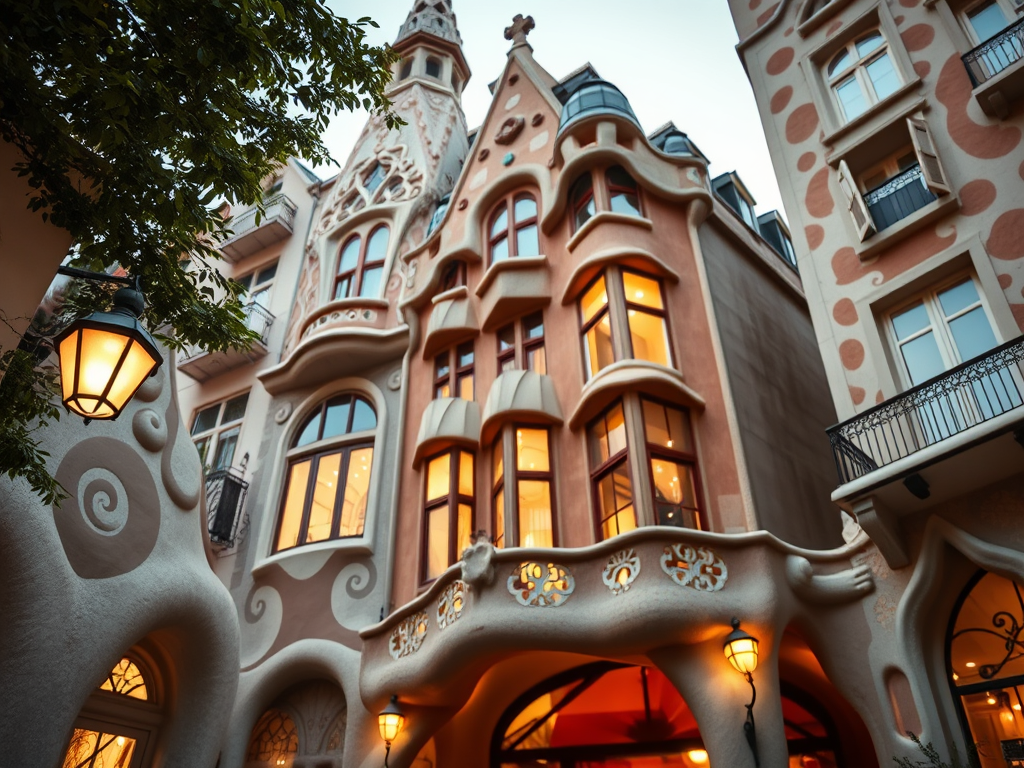
Barcelona is shaped by Gaudí’s work. From the undulating façade of Casa Batlló, which ripples like ocean waves, to the forest of stone trees inside Sagrada Família, Antoni Gaudí transformed this Catalan city into a living gallery of organic architecture. His buildings stand and breathe in Barcelona. This guide takes you through every essential Gaudí site, exploring what makes his architecture feel less like construction and more like nature’s own design rendered in stone, tile, and iron.
The Colour of Gaudí’s Barcelona


Gaudí’s world explodes in aquamarine mosaics that catch the Mediterranean light, dragon scales glazed in iridescent greens and golds, and stained glass that transforms ordinary sunlight into liquid colour pouring across floors.
His signature trencadís technique, broken ceramic tiles reassembled into flowing patterns, creates surfaces that shimmer and shift depending on the hour. Morning light turns Casa Batlló’s façade into pale turquoise silk. By afternoon, it deepens to sapphire. At sunset, the entire building seems to glow from within, as if the ocean had been frozen mid-wave and set against Passeig de Gràcia.
But colour here is more than decorative, it’s structural. Gaudí understood that in Barcelona’s sharp light, colour creates form. The gradient tiles in Casa Batlló’s inner courtyard move from deep cobalt at the top to pale aqua below, compensating for diminishing natural light so every floor receives the same luminous quality. Even his whites aren’t simple: they’re layered, textured, alive with shadow and reflection.
Getting There: The Wrong Train Becomes the Right Journey
I stayed near Palamos in Catalonia and travelled to Barcelona by train. Unintentionally booking the slow coastal train from Girona to Barcelona, a two-hour-and-twenty-minute trip, instead of the direct forty-five-minute express felt like a mistake at first. Standing at Girona Station, giving myself an internal lecture for not learning Spanish, I watched the sleek, fast train depart while I waited for my lumbering local.
But as we hugged the coastline, the Mediterranean revealed itself: deep aqua-blue water lapping against beaches where sun-kissed locals waved at the passing train, entirely unbothered by their birthday suits.
Mid-journey, a passenger stood up with a microphone and belted out “I’m Only Human” by Rag’n’Bone Man. No preamble, no explanation, just a voice filling the carriage. By the second chorus, half the passengers sang along. A few stations later, a man boarded with a backpack of “bits and bobs.” He handed out bottled water, a mango, and various snacks, then disappeared.
By the time we pulled into Barcelona, I understood: even the wrong train can take you somewhere wonderful. The journey’s uniqueness had become its own highlight.
Casa Batlló: The House of Light and Sea
First Impressions
Walking down Passeig de Gràcia in the Eixample district, Casa Batlló announces itself like a creature from a fairy tale, shimmering among traditional storefronts. The aqua-painted façade ripples like waves frozen mid-motion, wrapping around windows adorned with mosaic tiles. Above it all, a dragon-shaped roof covered in iridescent scales looms. A tribute to Sant Jordi, Catalonia’s patron saint, and the legendary beast he defeated.
I knew Casa Batlló would be extraordinary. I wasn’t prepared for how otherworldly it would feel.


The Architecture of Dreams
Every detail echoes nature’s artistry. Window structures recall skulls and bones, adding eerie beauty to organic forms. Interior skylights resemble turtle shells. The magnificent wooden staircase spirals upward like the backbone of a giant creature, its carved handrail snaking through impossibly curved spaces.
Every corner pulses with detail. In the study, sunlight catches on 24-carat gold leaf, spilling warmth across a space that once hosted serious business. Beyond it, the mushroom-shaped chimney hugs a heated lover’s seat carved into its nook. I stood imagining the whispers and stolen kisses it must have overheard over the years.
The inner courtyard demonstrates Gaudí’s genius for light manipulation. Gradient tiles shift from deep cobalt at the top to pale aqua at the bottom, ensuring every floor receives balanced illumination as natural light decreases. It’s engineering disguised as art.
Later, perched on the rooftop with prosecco in hand, I gazed over the dragon’s glistening tail and the army of chimneys. The house says more about the Batlló family than it does about Gaudí. They didn’t just commission a home; they gave an architect full creative rights to dream out loud.
Reflection: Gaudí never worked solely from flat blueprints. He built three-dimensional models, used mirrors to study light, and constantly adjusted designs during construction.
Casa Milà (La Pedrera): The Quarry
Wind-Sculpted Stone
Just steps from Casa Batlló, Gaudí conjured his next project. Known as La Pedrera, “The Quarry,” its façade ripples with rhythm, as if wind and water had carved it slowly over centuries. No straight lines exist here; every surface curves, flows, and suggests movement frozen in stone.


Inside the Wave
The building reveals different personalities across its floors. Ground-level apartments feature marble floors surrounding a courtyard and what was, for its era, revolutionary: the area’s first residential car park. In Gaudí’s time, important people wore hats and carried parasols. He viewed the ceiling as “the hat of the house”, and the higher you climb, the more his architectural magic intensifies.
The attic arches like a creature’s ribcage, each curve supporting the structure while creating cathedral-like space. On the rooftop, chimneys stand as warriors mid-battle, abstract and sculptural. They’re ventilation shafts that happen to look like an army of guardians watching over Barcelona.
The view of the city spreads in every direction. From here, you understand that Gaudí didn’t design buildings to sit in cities; he designed them to transform urban landscapes into something between architecture and sculpture.
Reflection: Unlike Casa Batlló’s oceanic fantasy, La Pedrera feels more conservative but with a Guadi twist. Same architect, same street, completely different emotional register. Gaudí proved he could channel nature’s full range: water and stone, lightness and weight, fantasy and permanence.
Park Güell: A Garden City Turned Dreamscape
The Dragon’s Welcome
Park Güell began as an ambitious, failed real estate project. Eusebi Güell commissioned Gaudí to design a luxury housing development modelled on English garden cities. When only two houses sold, the project collapsed. The city converted it to public parkland in 1926. Failure produced one of Barcelona’s greatest treasures.
The dragon fountain guards the monumental steps with theatrical flair, scales glittering in bursts of turquoise, orange, and gold. I found myself mesmerised like a child eyeing a mythical creature, half-expecting it to snort confetti. This mosaic salamander has become Barcelona’s unofficial mascot, photographed millions of times but never losing its capacity to surprise.


Where Stone Flows
The deeper I wandered, the more my brain struggled to process what I saw. Stone isn’t supposed to flow. Columns spiral like ancient oaks, their surfaces textured to resemble bark. Ceramic mosaics ripple like skin under sunlight. The serpentine bench stretches and slinks like a sun-soaked snake lounging without care. Everything feels alive, as if architecture took a breath and decided to play.


Gaudí embedded bird nests into walls, not decorative touches, but functional homes designed to invite nature in. This wasn’t just landscape architecture; it was ecological architecture before the term existed. He understood that buildings should support life beyond human habitation.
The main terrace offers panoramic views of Barcelona and the Mediterranean. From here, you see how Gaudí positioned the park to capture light, frame vistas, and create spaces that feel both monumental and intimate.
Sagrada Família: The Eternal Masterpiece
Approaching the Vision
Before entering, Sagrada Família casts its spell. The basilica towers, part cathedral and part celestial vision, dominate Barcelona’s skyline with breathtaking presence.
Gaudí spent over forty years breathing vision into stone, crafting space where light spills like water through coloured glass and every curve pulses with meaning. He knew he wouldn’t see completion. When asked about the slow progress, he replied: “My client is not in a hurry.” His client was God.


The Nativity Façade
The Nativity Façade faces morning sun, its carvings telling stories that feel familiar yet strange. Turtles and lizards guard the entrance, symbols of land and sea. Angels trumpet new beginnings. Even rain spouts are shaped like open-mouthed creatures. Faith, Hope, and Charity frame the doorway like three gentle reminders of what matters.
One detail shook me: the haunting sculpture of Herod’s decree tucked into the Portico of Hope. It’s heavy, emotional, and unexpectedly raw for a façade celebrating birth. But that’s this place’s magic – joy and sorrow coexist, both in service of faith.
Gaudí didn’t rely on flat sketches. He used everything from clay to vegetables to model ideas. He made plaster casts from real animals to shape the façade’s lifelike details. When critics questioned his unconventional methods, he pointed to nature: “Originality consists in returning to the origin.”
Inside: The Forest of Light
Stepping inside renders you speechless. Columns branch like trees, supporting a canopy of vaulted ceilings that recall walking through a forest. But this forest is made of stone that soars eighty meters high, creating space that feels both ancient and futuristic.
Light transforms everything. Stained glass windows with deep blues and greens on one side, warm reds and oranges on the other. Coloured light pours a kaleidoscope of coloured illumination across white stone. Morning light creates a cool, meditative atmosphere. The afternoon brings warmth, passion, and energy. The building breathes with the sun’s movement.
Gaudí studied natural forms obsessively. He observed how trees distribute weight, how light filters through leaves, and how nature elegantly solves structural problems. The columns here lean at angles calculated to carry weight most efficiently, not because it looks interesting, but because that’s how trees stand.
The Unfinished Cathedral

It’s still unfinished, with completion projected for around 2026 – the centenary of Gaudí’s death. Somehow, that incompleteness makes it more powerful. Like faith itself, it’s constantly evolving, slowly reaching toward heaven, one stone at a time.
The Passion Façade, designed after Gaudí’s death based on his plans, presents a stark contrast to the Nativity’s ornamentation. Sculptor Josep Maria Subirachs created angular, almost brutal figures that convey suffering without sentimentality. Some critics hate it. I find it honest, grief and loss don’t come wrapped in decorative beauty.
Reflection: Sagrada Família isn’t just Gaudí’s masterpiece, it’s his testament to patience, faith, and the idea that some works transcend individual lifetimes. We’re building it for future generations who will, in turn, maintain it for theirs. In our age of instant gratification, there’s something profound about architecture that requires multiple generations to complete.
Experiencing Gaudí’s Barcelona
Practical Flow
Start with Casa Batlló in morning light when the façade glows softest. Walk to Casa Milà (five minutes away) for mid-morning before crowds peak. Take lunch in the Eixample, then head to Park Güell for afternoon light and sunset views. Save Sagrada Família for a separate visit; you’ll want hours inside.
Book all tickets online in advance. Casa Batlló and Sagrada Família sell out days ahead during peak season. Consider audio guides at each site as they provide context that transforms appreciation into understanding.
The Sensory Experience
Gaudí’s architecture engages all senses. You hear differently inside his spaces as sound moves strangely through curved surfaces, creating unexpected acoustics. You touch constantly, running hands along railings that fit palms perfectly, feeling mosaic textures, experiencing how he designed for human interaction.
Temperature changes as you move through buildings. Gaudí engineered natural ventilation before air conditioning existed. His spaces breathe, drawing cool air up from lower floors, expelling warm air through carefully positioned vents.
Even smell plays a role. The stone in Sagrada Família has a particular mineral scent. Park Güell carries pine resin from surrounding trees. These aren’t incidental details—they’re part of total sensory design.
Beyond the Major Works
Time permitting, explore Gaudí’s lesser-known Barcelona projects:
Casa Vicens (1883-1888): His first major commission, showing Moorish influences before his style fully matured. The checkerboard façade and intricate interior tilework reveal a young architect already pushing boundaries.
Palau Güell (1886-1890): An early mansion for his patron Eusebi Güell, featuring a stunning rooftop of mosaic chimneys and a central hall with a domed ceiling pierced by circular openings that create a planetarium effect.
Colònia Güell Church Crypt (outside Barcelona): An experimental project where Gaudí tested structural techniques later used in Sagrada Família. The raw, almost brutalist interior feels remarkably contemporary.
Leave your thoughts